Loading
Manufacturing Consultant · Manufacturing SEO Blog
What Is AI Search Optimization and Why Does It Matter?
Learn what AI Search Optimization (AEO) means for manufacturers and how Digifacturing structures your site so ChatGPT, Gemini & AI Overviews cite you.
By Tarun Gurwara, Manufacturing Growth Consultant, Digifacturing — Ahmedabad, India. About Tarun →
Quick Answer
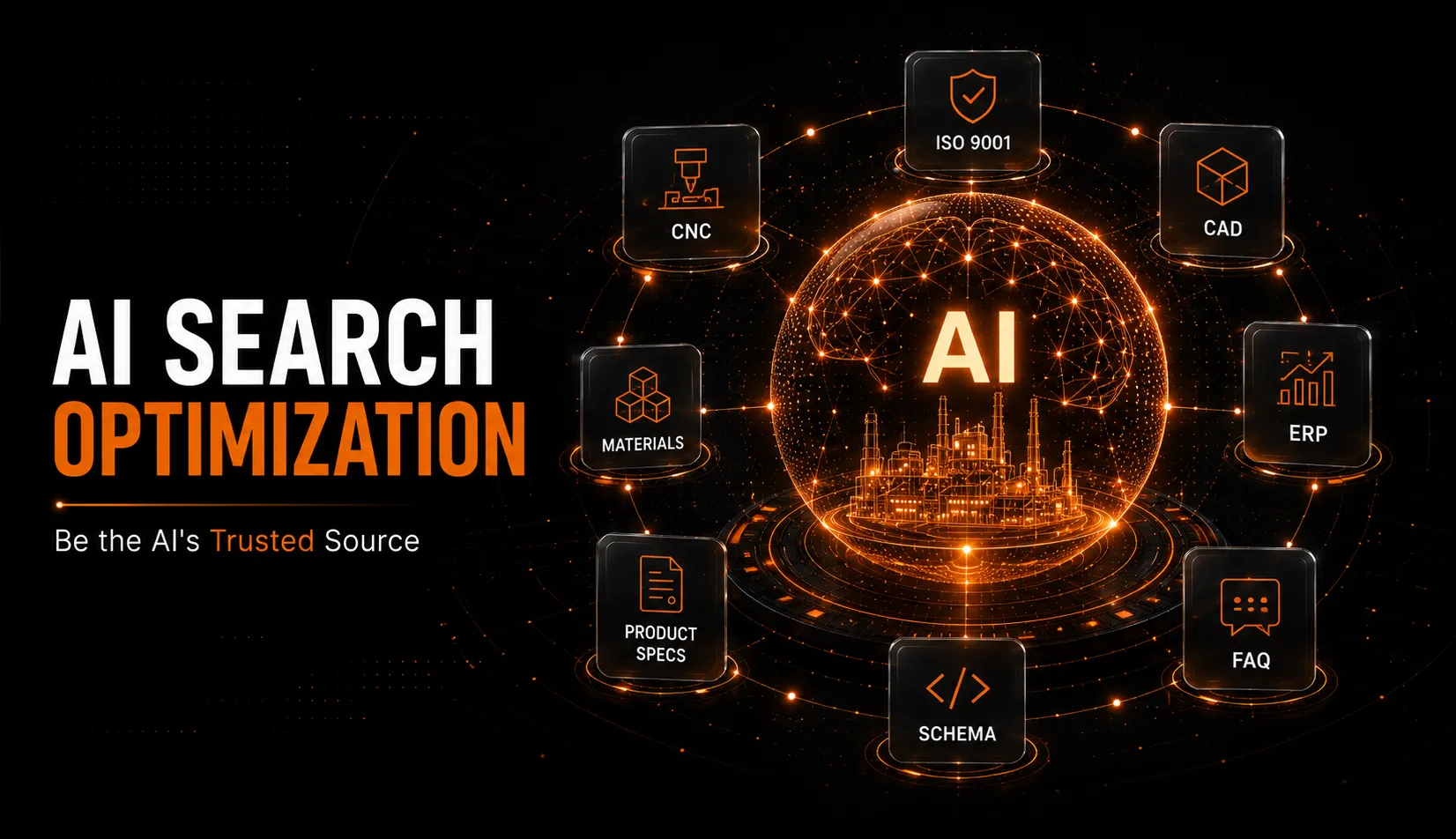
AI Search Optimization (AEO) is the practice of structuring your website's content so AI models like ChatGPT, Gemini, and Perplexity can extract, verify, and cite your business as a trustworthy source when answering a procurement question. It matters for manufacturers because buyers increasingly research suppliers inside AI tools before visiting a single website, and a company that is not structured for AI extraction is effectively invisible to that research process, regardless of how strong its actual capabilities are.
Get a Free AEO AuditThe Paradigm Shift: From Search Engines to Answer Engines
For the past two decades, SEO focused on one job: ranking a link high enough that a human would click it. In 2026, users increasingly want an immediate, synthesized, technically accurate answer generated by large language models instead of a list of links to sort through.
For manufacturers, this is not a marginal trend. Your technical capabilities, certifications, and product data are now being read, summarized, and used by AI systems to make purchase recommendations. If your site is not built for this kind of extraction, you are effectively invisible to a growing share of procurement research, even if your shop floor is excellent.
In the old model, you competed for attention on a results page. In this new model, you compete to be the entity an AI system trusts enough to recommend by name.
Why This Shift Is Happening Now
Three forces are converging: AI assistants have become accurate and fast enough that professionals trust them for early-stage technical research, manufacturing procurement cycles are long and technical enough to be a natural fit for AI-assisted comparison, and most suppliers have been slow to adapt their sites away from digital brochures.
AEO is still early enough that being thorough and correct about it today puts you ahead of nearly your entire competitive set. That is the real opportunity.
Why Manufacturers Get This Wrong
Across the manufacturing websites we audit, three gaps come up repeatedly:
1
Websites Built as Digital Brochures
Most manufacturers still treat their websites as digital brochures rather than structured data sources. This creates an outsized advantage for the few who structure their content correctly today, since AEO is still early enough to get ahead of an entire competitive set.
2
Content With No Checkable Facts
General claims like being a trusted manufacturer with years of experience give an AI system nothing to work with beyond an impression — exactly the kind of content AI models are trained to deprioritize.
3
Traffic Moving Somewhere SEO Doesn't Reach
As more procurement managers research vendors inside AI platforms, raw website traffic from search is declining for many manufacturers even as overall buyer research activity increases. The activity hasn't disappeared, it has moved.
A Practical Example: Grounded vs. Ungrounded Content
An AI system asked to recommend a supplier is, in effect, trying to avoid being wrong. The more specific and verifiable your data is, the safer a bet you become:
Ungrounded content
"We are a trusted manufacturer of industrial components with years of experience serving multiple sectors" gives an AI model nothing checkable to match against a buyer's requirement.
Grounded content
"We manufacture precision industrial components to ISO 9001:2015 standards, with tolerances to ±0.01 mm, serving the automotive, aerospace, and energy sectors since 2010, with current production capacity of 10,000 units per month" gives the AI specific, checkable facts.
The compounding advantage
Pre-qualified authority, reduced sales friction, and a competitive moat all follow once an AI model has integrated your brand into its knowledge graph as the reference answer for a category.
Core Pillars of AI Search Optimization
AI systems do not rank websites the way a search engine does. They evaluate the authority of entities and the verifiability of facts:
01
Semantic Clarity and Entity Mapping
We map your services to clear, industry-standard entities LLMs already recognize, consistently pairing terms like CNC Machining with specific certifications, exact tolerances, and the sectors you serve so the AI builds one consistent picture of your business, not a fragmented one.
02
The Grounding Principle
We present your capabilities in structured formats — tables of production capacity, lead times, and compliance standards — giving the AI exactly the verifiable data it needs to recommend your firm with confidence instead of hedging. Read more on How to Appear in ChatGPT & AI Recommendations →
03
Machine-Readable Structure
We implement hierarchical headers, JSON-LD structured data, and conversational Q&A content addressing specific procurement pain points, so AI agents can extract your answers cleanly instead of inferring them from prose.
04
Integrating AEO Into Your Wider Content Strategy
The same grounded, specific, well-structured content that earns AI citations also performs better in traditional search and converts better once a human reader arrives — we treat it as one content strategy, not a separate project. See also Can AI Generate Leads for Manufacturing Companies? →
Why AEO Matters for Manufacturing Growth
If your company appears in an AI response as a recommended solution, you gain compounding advantages: pre-qualified authority, since the AI has effectively vetted your capabilities before the buyer visits your site; reduced sales friction, since the buyer arrives already understanding why you're a technical match; and a competitive moat, since it's significantly harder for a competitor to displace a brand AI models have already integrated as the reference answer.
These advantages directly support stronger B2B lead generation, higher-quality manufacturing leads, and more effective export marketing strategies. The activity has not disappeared. It has moved.
Signs Your Manufacturing Site Isn't AEO-Ready
You likely have a gap if: your service descriptions use general industry terms with no linked certifications or tolerances, your site has no data tables showing production capacity or lead times, your content reads as prose with no clear headers or Q&A structure, and no page carries JSON-LD schema. If several of these sound familiar, start with How to Appear in ChatGPT & AI Recommendations →.
How Manufacturing Consultant Helps With AI Search Optimization
We audit your current entity mapping, grounding, and structure, then rebuild capability pages around specific certifications, tolerances, and production data instead of general claims. We implement JSON-LD schema and conversational Q&A content so AI agents can extract your answers cleanly.
Our objective is not simply adding more content. Our objective is making your business a source an AI model can verify and trust enough to cite.
Get a Free AEO AuditWant to Know How You Measure Up on AI Visibility?
Connect with Tarun Gurwara on WhatsApp and book a free 30-minute AEO audit covering entity mapping, grounding, and structure.
Frequently Asked Questions
EntityCommercial
How does AI Search Optimization differ from traditional SEO?
Traditional SEO focuses on keyword density and link building to improve rankings. AI Search Optimization focuses on entity authority, semantic structure, and data grounding, enabling AI models to extract and cite your business as an authoritative source.
Entity
Can a small manufacturing firm compete with large corporations in AI search?
Yes. AI models often prioritize technical authority and topical expertise over overall domain authority. Manufacturers that publish highly specific technical content can become trusted sources for AI-generated answers even against larger competitors.
EntityCommercial
What is the role of structured data in AEO?
Structured data using JSON-LD helps AI systems understand your business by providing machine-readable information about your services, certifications, products, location, and organization.
Commercial
How long does it take to see results from AI Search Optimization?
AI Search Optimization generally produces results over several months rather than weeks. Manufacturers that consistently publish authoritative content and implement structured data are more likely to see improved AI visibility over time.
Entity
Does AEO replace the need for traditional SEO?
No. AI Search Optimization complements traditional SEO. Practices such as clear structure, accurate technical information, and structured data benefit both search engine rankings and AI-generated search experiences.
EntityCommercial
Should I hire an agency or do digital marketing in-house for AEO?
For complex technical manufacturing products, partnering with a specialized manufacturing business growth consultant or industrial marketing agency almost always outperforms a general digital agency or pure in-house team.
Structure for Extraction
Become the Source AI Systems Trust
Book a free 30-minute AEO audit with Tarun Gurwara and find out exactly how your site measures up on entity mapping, grounding, and structure.
Ahmedabad, Gujarat, India · Digifacturing · Tarun Gurwara