Loading
Manufacturing Consultant · Manufacturing SEO Blog
Can AI Generate Leads for Manufacturing Companies?
AI can generate manufacturing leads — but only with the right setup. See how Digifacturing uses AI for qualified, high-intent industrial sales leads.
By Tarun Gurwara, Manufacturing Growth Consultant, Digifacturing — Ahmedabad, India. About Tarun →
Quick Answer
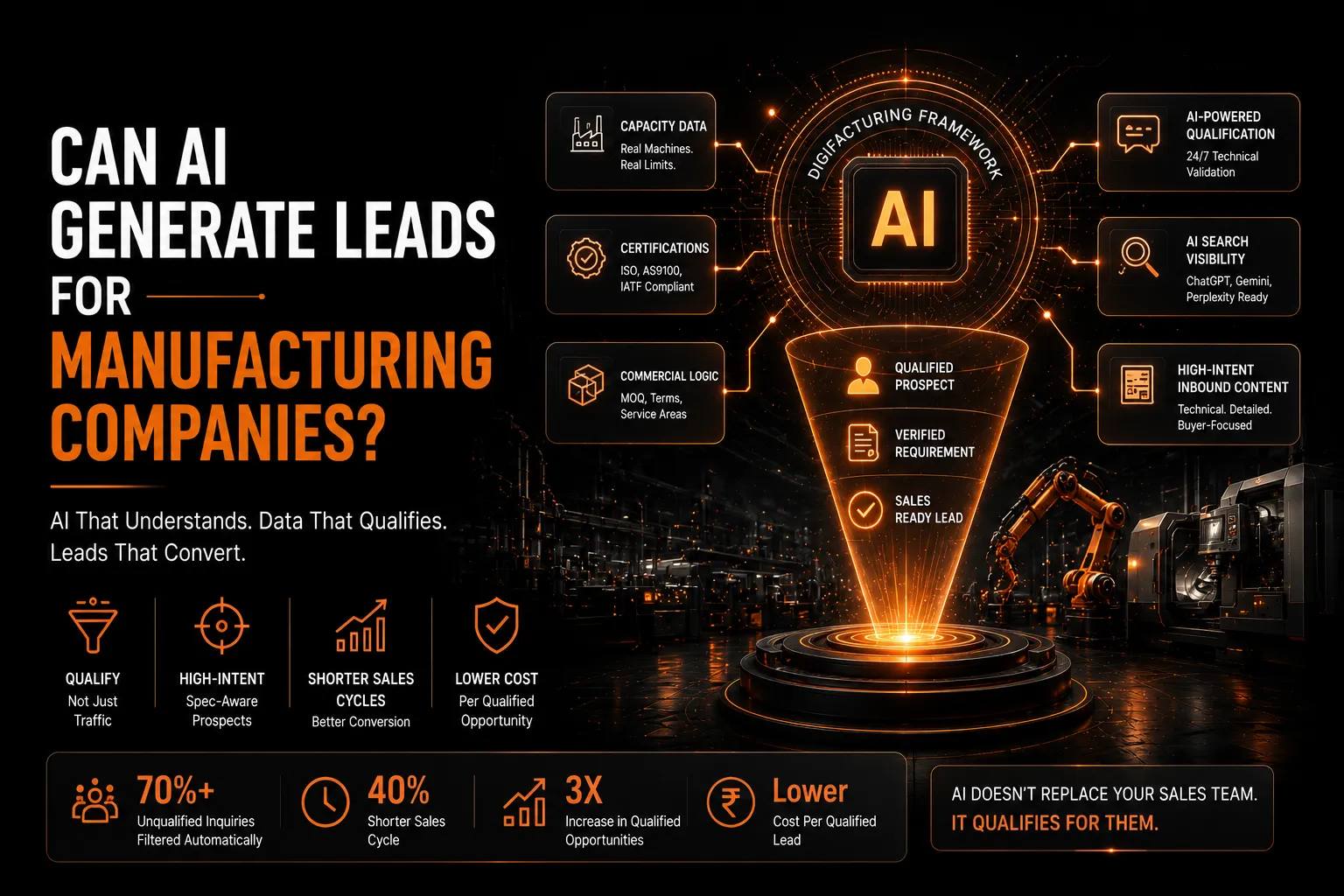
Yes, AI can generate leads for manufacturing companies — but not as a volume tool. Used correctly, AI works as an automated technical qualification layer: it filters website visitors using your real capacity, certification, and MOQ data, and only passes high-intent, spec-aware prospects to your sales team. Manufacturers who treat AI as a qualification gatekeeper, not a traffic generator, see fewer but far higher-quality leads, shorter sales cycles, and a lower cost per qualified opportunity.
Get a Free AI-Readiness AuditWhy This Question Gets the Wrong Answer Most of the Time
Most manufacturers asking whether AI can generate leads have already been burned once — a chatbot widget or an outsourced AI lead gen service produced a spike in form fills their sales engineers immediately discarded as wrong region, wrong volume, or wrong material. The conclusion they draw is that AI doesn't work for B2B manufacturing.
AI fails when it is deployed the way it is sold to e-commerce and SaaS companies: maximize top-of-funnel volume and let sales sort it out. A procurement engineer evaluating a supplier for AS9100-certified components runs a multi-week technical and commercial vetting process, often with three to seven stakeholders, before a single RFQ is issued.
The manufacturers who get real value from AI flip the objective from more leads to enforcing fit before contact. Qualification over volume is the difference between AI being a gimmick and AI becoming a genuine sales asset.
The Myth of AI "Magic" in Industrial Sales
There is a pervasive myth that AI can act as a black box where you input capital and output immediate RFQs. In B2B manufacturing, where sales cycles span months and require deep technical vetting, this model is dangerous. AI does not replace the human engineer — it automates the technical discovery phase that currently consumes hours of your sales team's week.
Industrial buyers are starting research conversations inside AI assistants before they touch a search engine. If your capabilities are not structured for those systems to read and cite, you lose the lead before the funnel even starts.
Why Most AI Lead Generation Fails in Manufacturing
After reviewing multiple failed AI rollouts, we consistently see the same three root causes:
1
AI Deployed for Volume, Not Fit
Most manufacturers who try a chatbot widget or generic AI content tool get a spike in form fills their sales engineers immediately discard — wrong region, wrong volume, wrong material. That failure is a deployment problem, not proof AI doesn't work for industrial buyers.
2
AI Ungrounded in Operational Reality
Generic AI tools work from homepage copy, not your actual capacity, certifications, or commercial logic. Without grounding in real data, the AI cannot answer technical queries with the accuracy a senior sales engineer would, and risks overstating what you can produce.
3
Content Built for Consumers, Not Procurement Engineers
A procurement engineer evaluating an AS9100-certified supplier runs a multi-week technical and commercial vetting process with several stakeholders. AI built for consumer-style volume optimization actively works against that buying pattern.
Grounding AI in Your Technical Source of Truth
AI can only generate qualified leads if it actually understands your manufacturing capabilities at the level of detail a senior sales engineer would. Generic AI tools fail here because they work from homepage copy, not operational reality:
Capacity constraints
Maximum and minimum machine tolerances, part dimensions, and batch sizes your equipment can realistically support need to be documented before AI can qualify a lead against them.
Certification data
ISO, AS9100, IATF, or sector-specific certifications, including scope and expiry, so the AI never overstates what you are actually qualified to produce.
Commercial logic and material limits
MOQ thresholds, payment terms tolerance, geographic service boundaries, and the alloys, finishes, and processes you support in-house versus what you'd need to subcontract.
The Digifacturing Integration Strategy
AI lead generation in manufacturing succeeds or fails on data grounding, not on prompt engineering or ad spend. Our framework runs across four phases:
01
Training AI on Your Technical Source of Truth
We ground AI agents in your real capacity constraints, certification data, MOQ thresholds, geographic service boundaries, and material and process limits, so the AI never overstates what your shop floor can actually deliver.
02
From Traffic to Technical Intent
We target deep technical queries like surface finish requirements for medical-grade stainless steel or MOQ for 5-axis titanium machining, instead of broad consumer-style keywords that tell you nothing about buyer fit. Read more on Why Manufacturers Don't Show Up on Google →
03
Improving AI Search Visibility (AEO/GEO)
Content structured around deep technical intent, with clear Quick Answer blocks and FAQ schema, is exactly the format AI Overviews and tools like ChatGPT prefer to cite when a buyer asks who handles a specific tolerance or certification.
04
Deploying AI as a Qualification Gatekeeper
Intelligent RFQ intake, dynamic lead scoring, automated routing, and objection handling at the data layer mean your sales engineer's first conversation is a technical discovery call, not a qualification call. See also How to Increase Qualified B2B Leads in Manufacturing →
Manual Lead Generation vs. AI-Augmented Digifacturing
In a manual process, your sales engineer does technical triage on every single inquiry, qualified or not — the most expensive use of their time. In an AI-augmented process, that triage happens before the inquiry ever reaches a human:
| Operational Metric | Manual vs. AI-Augmented |
|---|---|
| Initial Triage | Manual: sales review. AI-Augmented: automated technical qualification. |
| Content Utility | Manual: static corporate pages. AI-Augmented: dynamic, data-grounded technical specs. |
| Responsiveness | Manual: 24–48 hour latency. AI-Augmented: instant technical validation. |
| Prospect Intent | Manual: broad / price-shopper. AI-Augmented: high-intent / spec-aware. |
| Sales Focus | Manual: qualifying low-fit leads. AI-Augmented: closing high-margin, verified contracts. |
| AI Search Visibility | Manual: rarely cited by AI tools. AI-Augmented: structured for AI Overview / LLM citation. |
| Cost per Qualified Lead | Manual: high, from manual filtering. AI-Augmented: lower, filtering automated upstream. |
Signs Your Factory Is Ready for AI-Augmented Qualification
You are a strong candidate if: your sales engineers spend hours triaging RFQs that never should have reached them, your capacity and certification data already exists but is not exposed on your website, you get inquiries from AI tools referencing outdated or inaccurate capabilities, and your current contact form captures no technical detail before a human gets involved. If several of these sound familiar, start with How to Increase Qualified B2B Leads in Manufacturing →.
How Manufacturing Consultant Helps You Deploy AI Correctly
We document your capacity, certification, and commercial constraints in a structured format, ground your AI intake and content in that data, and configure intelligent RFQ intake, dynamic lead scoring, and automated routing so your sales team only sees pre-qualified, spec-aware prospects. We can deploy private or enterprise-grade AI instances so proprietary blueprints and CAD files never leave your firewall.
Our objective is not simply adding an AI widget to your site. Our objective is turning AI into a qualification gatekeeper, not a volume tool.
Get a Free AI-Readiness AuditNot Sure Where AI Fits Into Your Sales Process?
Connect with Tarun Gurwara on WhatsApp and book a free 30-minute AI-readiness audit of your manufacturing lead funnel.
Frequently Asked Questions
EntityCommercial
Is AI-generated lead quality higher than human-led outreach?
AI-generated lead quality is higher only when the system is grounded in your proprietary technical data. It removes the human error of manual follow-ups and ensures prospects are qualified against your capacity and certification constraints immediately.
Entity
Can AI handle proprietary engineering data securely?
Yes. By deploying private, local, or enterprise-grade AI instances, your proprietary blueprints, CAD files, and material specs stay within your firewall and never train public third-party models.
Commercial
Does AI-driven lead generation reduce my sales team's workload?
It changes the workload rather than just reducing it. It eliminates time spent on bad leads that do not meet your MOQ or material requirements, letting your team focus on technical discovery and complex deal closing.
EntityCommercial
How does AI know if a lead is qualified for my specific factory?
You program the AI with your specific success thresholds covering certification scope, MOQ, material capability, and geographic reach. If a lead fails any of these, the AI agent informs them upfront.
Commercial
How long does it take to set up an AI qualification system like this?
Most of the work is documenting capacity, certification, and commercial constraints in a structured format. Manufacturers with this data already organized can typically deploy a working system within a few weeks.
Entity
Will this replace my website's existing contact form?
Not necessarily. It can sit alongside the existing form as a smarter intake layer, or replace it entirely depending on current lead volume and how much qualification work is currently done manually.
EntityCommercial
Should I hire an agency or do this in-house?
For complex technical manufacturing products, partnering with a specialized manufacturing digital transformation consultant or industrial marketing agency almost always outperforms a general digital agency or pure in-house team.
Qualification Over Volume
Turn AI Into Your Qualification Gatekeeper
Book a free 30-minute AI-readiness audit with Tarun Gurwara and find out exactly where AI could plug into your current sales process.
Ahmedabad, Gujarat, India · Digifacturing · Tarun Gurwara