Loading
Manufacturing Consultant · Manufacturing SEO Blog
How to Increase Qualified B2B Leads in Manufacturing
Improve your industrial sales pipeline. Learn strategic methods to filter inquiries, establish commercial thresholds, build an ICP, and capture high-intent B2B manufacturing leads.
By Tarun Gurwara, Manufacturing Consultant, Digifacturing — Ahmedabad, India. About Tarun →
Quick Answer
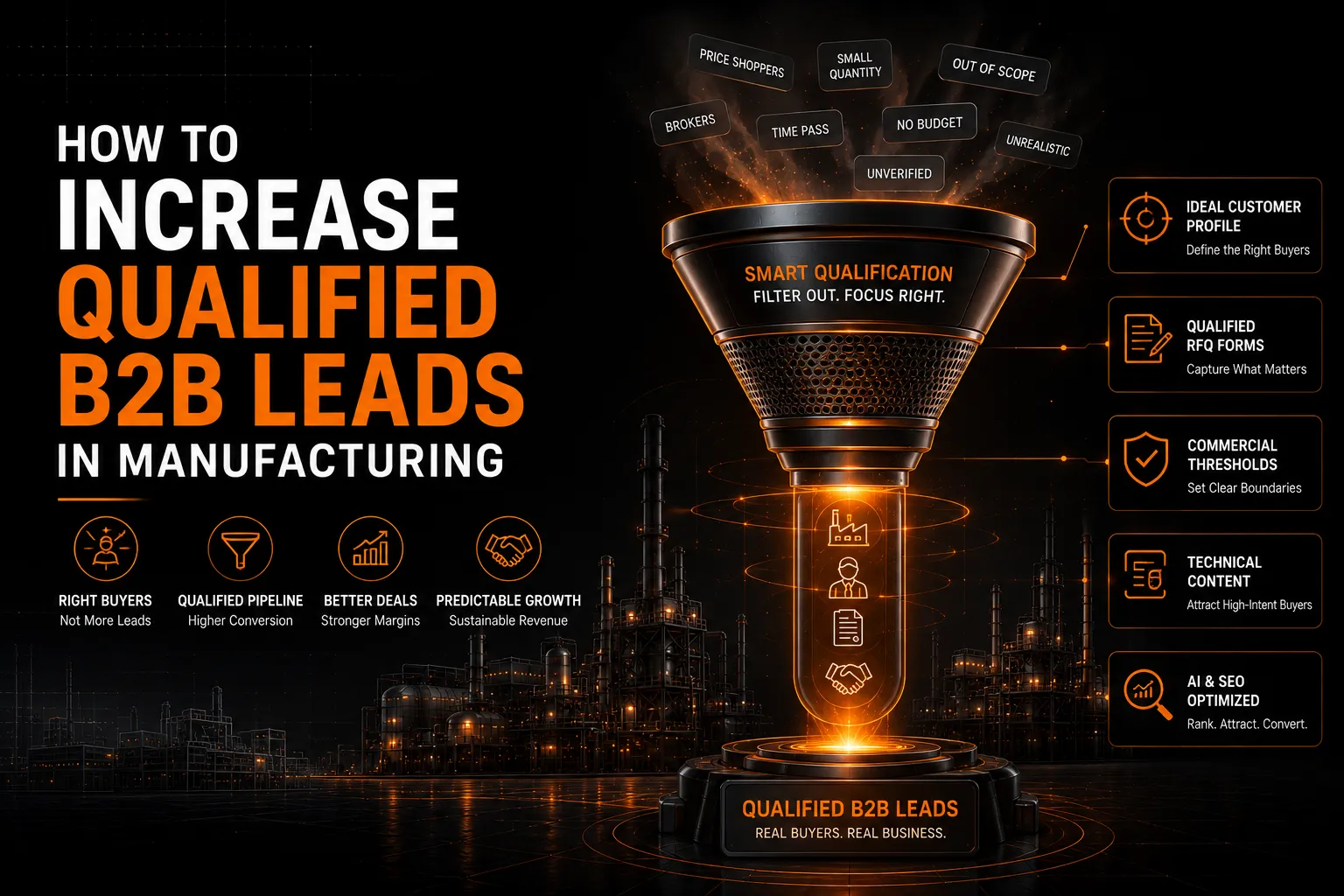
More leads do not automatically equate to higher revenue. Manufacturers increase qualified B2B leads by defining a rigid Ideal Customer Profile, introducing strategic friction into RFQ forms (corporate domain authentication, technical uploads), stating MOQs and service boundaries explicitly, and shifting content targeting from broad terms to high-intent, AI-searchable technical queries. The goal is a smaller volume of inquiries with a far higher close rate.
Get a Free Lead Qualification AuditIntroduction
For many industrial manufacturers, managing production capacity is rarely the primary challenge — the true bottleneck lies in pipeline integrity. Operating under a volume-based mindset often leads businesses to measure success solely by the sheer count of inbound inquiries, even when a large share of those inquiries sit entirely outside production parameters.
Through the Digifacturing methodology, industrial organizations transition from passive volume accumulation to strategic pipeline qualification by establishing rigid ICPs, transparent commercial thresholds, and technical authentication during data capture.
Most manufacturers do not suffer from a lead volume problem. They suffer from a lead qualification problem. A mature digital infrastructure should filter, not just funnel.
The True Cost of Pipeline Inefficiency
If you manage a manufacturing plant or oversee sales for an OEM, you are likely familiar with the drain of bad inquiries — startups seeking single prototypes, overseas buyers with zero import clearance, or buyers who cannot meet your production scale.
Bad Inquiries → Engineering Time Lost → Inflated CAC → Margin Erosion. Most manufacturers measure lead volume. Very few measure lead qualification. Yet qualification is where profit is actually won or lost.
Why Unqualified Leads Keep Slipping Through
After conducting multiple pipeline audits, we consistently see the same three operational costs:
1
Engineering Burnout From Unqualified Quotes
Lead application engineers spend valuable time calculating custom quotes for prospects who vanish the moment they see tooling costs or Minimum Order Quantities, pulling capacity away from serious buyers.
2
Inflated Customer Acquisition Cost
Every hour an experienced sales engineer spends on an unqualified lead drives up your overall customer acquisition cost and pulls focus away from major enterprise accounts.
3
Margin Erosion From Misaligned Contracts
Winning a contract outside your optimal operating parameters often results in production bottlenecks, low shop floor efficiency, and thin profit margins.
The Three Layers of an Industrial ICP
You cannot build an effective digital qualification filter until you have documented precisely who you are filtering for:
Firmographics
Company revenue, employee headcount, and geographic manufacturing hubs define the accounts that yield your highest profit margins — whether that's Tier-1 automotive suppliers, aerospace OEMs, or heavy machinery contractors.
Technographics
The ERP platforms your targets run (SAP, Epicor), the certifications they require (AS9100, ISO 13485, IATF 16949), and the dimensional tolerances or alloy grades they demand all shape whether a lead is a genuine fit.
Trigger events
A qualified lead is the right company at the right moment — expanding a production line, reshoring supply chains, or facing a compliance deadline that requires upgraded mechanical components.
The Lead Qualification Framework We Use
With your ICP clearly defined, we rebuild your digital infrastructure to execute the qualification process automatically, across four phases:
01
Phase 1: Restructure Lead Capture for Intent Verification
We block form submissions from generic email providers, require verified corporate domains, introduce progressive profiling, and add technical validation uploads for engineering blueprints and CAD models so unqualified prospects self-select out.
02
Phase 2: Establish Transparent Commercial Thresholds
We define Minimum Order Quantities explicitly on capability pages and state service boundaries clearly, such as manufacture-to-print only with no in-house R&D, so early-stage startups and price-shoppers are deterred before they reach your sales team.
03
Phase 3: High-Intent Answer Engine Optimization (AEO)
We build landing pages around precise engineering capabilities, such as custom 5-axis milling for titanium aerospace components, rather than broad terms, and format data for AI tools like ChatGPT, Perplexity, and Gemini to parse. Read more on Why Manufacturers Don't Show Up on Google →
04
Phase 4: Deploy Value-Driven Conversion Mechanisms
We gate technical resources like material selection guides and alloy comparison tools behind professional registration, then feed GA4 engagement data into your CRM for lead scoring so sales prioritizes the highest-intent prospects first. See also Beyond IndiaMART: Manufacturing Lead Generation →
The Closed-Loop Feedback System
The final step in building a predictable lead generation system is establishing a feedback loop between sales and marketing. A monthly pipeline review should evaluate disqualified leads together — if sales rejected inquiries for volumes too low, marketing tightens MOQ visibility on the site; if inquiries come from out-of-market regions, marketing refines geographic targeting.
Marketing drives traffic. Sales tracks disqualification reasons. This closed-loop system ensures your qualification filter tightens and improves month over month.
Warning Signs You Have a Lead Qualification Problem
You may have a qualification problem if: sales engineers spend most of their week on quotes that never close, your website has no visible MOQs or service boundaries, form submissions come mostly from free email addresses, out-of-market or overseas inquiries you cannot fulfill are common, and there is no formal feedback loop between sales and marketing. If several of these sound familiar, start with Why Manufacturers Don't Show Up on Google →.
How Manufacturing Consultant Helps Improve Lead Quality
We help industrial organizations conduct AI Visibility Audits and restructure their websites to act as automated qualification mechanisms. We define ICPs, rebuild RFQ forms with intent verification, make commercial thresholds explicit, and structure content for both Google and AI search platforms. We track results through Customer Acquisition Cost, Lead-to-Close ratio, and sales-reported disqualification reasons.
Our objective is not simply increasing inquiries. Our objective is ensuring your sales team only engages with verified, high-value procurement professionals.
Get a Free Lead Qualification AuditChecked Off 3 or More of These Warning Signs?
Connect with Tarun Gurwara and book a free lead qualification audit — we'll show you exactly where bad-fit inquiries are draining your engineering time.
Frequently Asked Questions
EntityCommercial
How is a qualified B2B lead defined in the manufacturing sector?
A qualified lead is an organization that aligns with your specific Ideal Customer Profile (ICP), meeting your MOQs, certification requirements, budget, and procurement timelines.
Commercial
Will introducing mandatory technical form fields reduce our total inquiries?
Yes. The objective is a lower volume of total submissions but a significantly higher percentage of sales-qualified opportunities, increasing overall operational efficiency.
Entity
What is Lead Scoring, and how do manufacturers use it?
Lead scoring is a methodology used to rank prospects against a scale that represents their perceived value. Manufacturers assign points for firmographic data and behavioral data, ensuring sales prioritizes the most qualified leads.
EntityCommercial
How does structuring content for AI engines improve lead quality?
By clearly defining tolerances and MOQs through structured on-page data, AI models only recommend your organization when a buyer's exact technical criteria match your capabilities, filtering out bad fits.
EntityGeo
How do we prevent out-of-market or international inquiries that we cannot fulfill?
Refine location parameters within digital advertising platforms, adjust search configurations, and explicitly define geographic service boundaries on your website to deter out-of-market inquiries.
Commercial
How long does it take to transition a website from volume-based to qualification-based?
Establishing the ICP and updating forms takes a few weeks. Rewriting content for high-intent Answer Engine Optimization and establishing CRM feedback loops typically requires 90 to 120 days.
Filter, Then Scale
Ready to Fix Your Lead Qualification Process?
Book a free 30-minute strategic lead qualification audit with Tarun Gurwara. You'll walk away with a clear map of where unqualified leads are entering your pipeline and exactly what to build next to filter them out.
Ahmedabad, Gujarat, India · Manufacturing Consultant · Tarun Gurwara