Loading
Digifacturing · Blog
Why Does My Website Not Generate Leads?
Written by Tarun Gurwara, Manufacturing Consultant, Ahmedabad — A Complete Guide to Turning Your Manufacturing Website into an RFQ Generation Engine
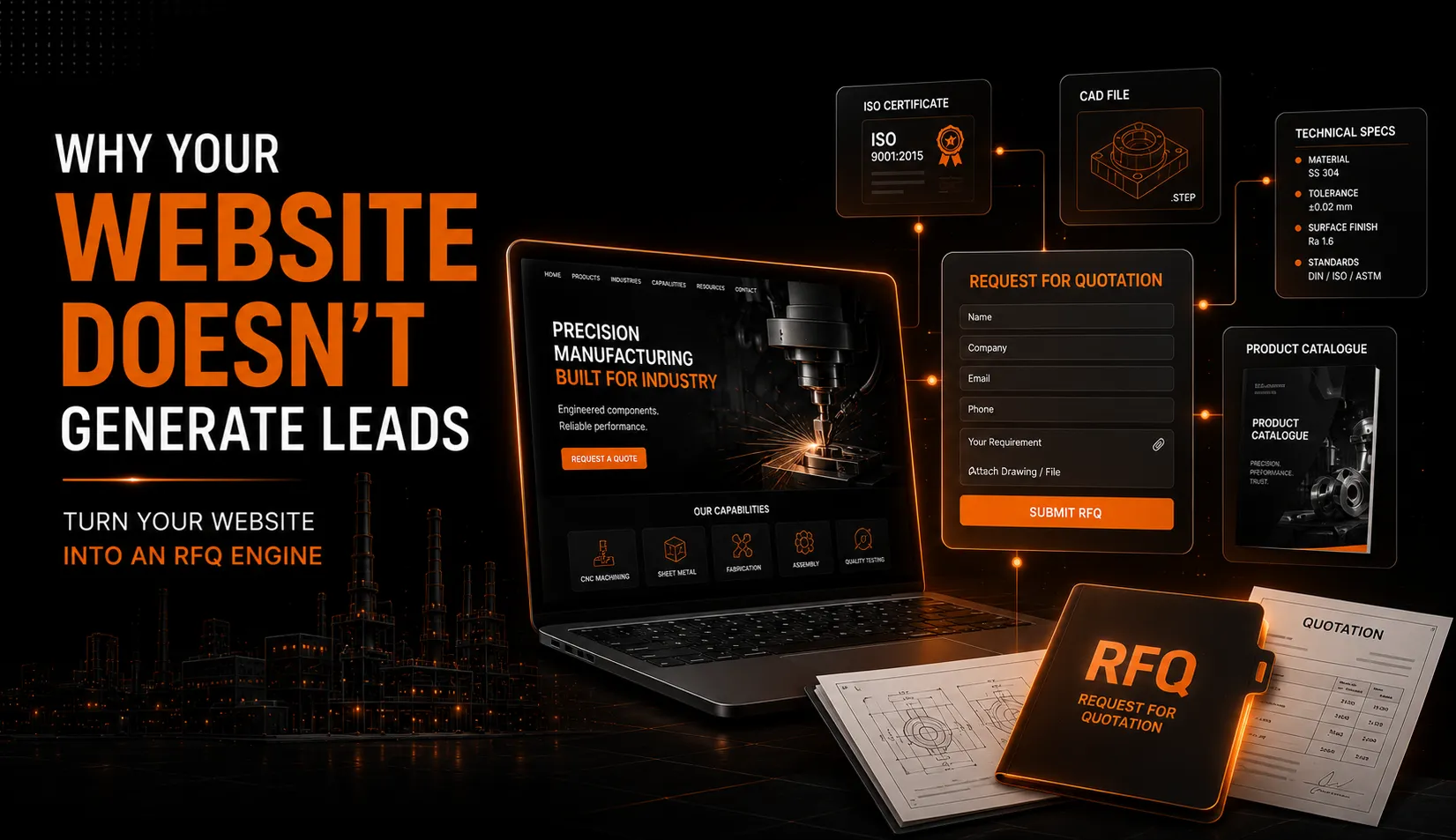
Many manufacturing companies invest in a professionally designed website, yet months or even years later they still ask why they aren't receiving inquiries, why buyers don't submit RFQs, or why competitors are getting more online leads. The problem is rarely that your website looks outdated. The real issue is that most manufacturing websites are designed as digital brochures, not as lead-generation systems.
Today's B2B buyers research suppliers extensively before making contact. They compare websites, evaluate technical expertise, verify certifications, review manufacturing capabilities, and increasingly use AI-powered search tools to shortlist suppliers. If your website fails to answer their questions or build trust, they simply move on to a competitor.
The Modern Manufacturing Buying Journey
Before contacting a supplier, procurement managers typically follow this digital journey, and your website influences every single stage of it:
- —Search on Google / AI — the buyer starts researching suppliers
- —Visit Website — your site gets the first real impression
- —Evaluate Products — specs and capabilities are compared
- —Review Certifications — trust signals are checked
- —Compare Suppliers — your site is weighed against competitors
- —Download Catalogs — technical evaluation deepens
- —Request RFQ — the buyer formally reaches out
- —Purchase Decision — the winning supplier is selected
10 Reasons Your Website Isn't Generating Leads
01
Your Website Is Built for Information, Not Conversion
Many manufacturing websites only include a company profile, product list, contact page, and gallery. This is not enough for modern B2B lead generation. A high-performing industrial website guides buyers toward a clear action on every page: what you manufacture, which industries you serve, what problems you solve, why buyers should trust you, and how they can request an RFQ.
02
You're Not Ranking Where Buyers Search
Even the best website cannot generate leads if buyers never find it. Without a robust manufacturing SEO strategy covering technical SEO, high-value keyword clusters, industry-specific pages, comprehensive product pages, internal linking, and authoritative backlinks, your competitors receive these inquiries instead.
03
Your Website Isn't Optimized for AI Search
Procurement professionals and sourcing engineers increasingly use AI platforms like ChatGPT, Gemini, Claude, Perplexity, and Copilot. Improving AI visibility means publishing in-depth technical guides, clear FAQ sections with schema markup, structured data tables, industry-specific sub-pages, and consistent semantic internal linking.
04
You Don't Build Enough Trust
Industrial purchases involve high value and high financial risk. Essential trust signals include ISO and industry-specific certifications, detailed manufacturing capability lists, factory photography and drone videography, engineering walkthrough videos, verified testimonials, and proven years of operational experience.
05
Weak Product Pages
Many product pages contain only a name, one generic image, and a short description. High-converting product pages include complete technical specifications and material grades, specific applications and industries served, international standards and manufacturing tolerances, downloadable CAD drawings, and related FAQs.
06
No Industry-Specific Landing Pages
Manufacturers often market one generic product catalog to every industry. Targeted pages such as control panels for pharmaceutical plants or CNC components for aerospace improve organic rankings, AI relevance, and conversion rates across domestic and international markets.
07
Poor Call-to-Action Strategy
Many websites hide contact forms deep within secondary pages. Every important product and service page should feature frictionless CTAs like request a quote, download catalogue, or talk to an expert, reducing the steps required for a procurement manager to reach your sales team.
08
Slow Website Performance
A slow-loading website causes procurement managers to bounce immediately. Optimizing Core Web Vitals, server response time, mobile responsiveness, and image compression directly influences both user experience and search engine visibility.
09
No Lead Capture System
Not every visitor is ready to buy immediately. Capture future opportunities using downloadable catalogs, technical whitepapers, compliance guides, email subscriptions, and product comparison sheets, then nurture these early-stage leads through automated email marketing.
10
You Don't Measure Website Performance
Without proper analytics, improving your digital presence becomes guesswork. Monitoring marketing, conversion, and revenue KPIs consistently is what separates factories that improve from those that stay guessing.
Core KPIs to Track
Without proper analytics, improving your digital presence becomes guesswork. Monitor these core metrics:
| Category | Metrics to Track |
|---|---|
| Marketing KPIs | Organic traffic growth, keyword rankings, AI search visibility metrics, bounce rates, and landing page performance |
| Conversion KPIs | RFQs and direct contact form submissions, call tracking, document download rates, and overall conversion rate percentage |
| Revenue KPIs | Qualified leads generated, quote-to-order ratio, customer acquisition cost, and revenue by marketing channel |
Manufacturing Website Audit Checklist
Evaluate your website against these critical questions:
| Area | Question |
|---|---|
| SEO | Do you rank for buyer-intent keywords? |
| AI Visibility | Can AI platforms identify your technical expertise? |
| Trust | Do you showcase certifications and case studies? |
| Products | Are technical specifications detailed and downloadable? |
| Industries | Do you have dedicated industry-specific landing pages? |
| CTAs | Is every page designed to generate RFQs? |
| Speed | Does your website load quickly on mobile and desktop? |
| Analytics | Are conversions measured accurately through trackers? |
The more "no" answers you have, the greater the opportunity to improve lead generation and scale your business digitally.
Turn Your Website into a 24×7 Sales & RFQ Generation Machine
A manufacturing website should do more than showcase your company. It should consistently attract qualified buyers, build trust, and generate high-value RFQs. We help manufacturers transform underperforming websites into high-converting lead generation platforms through:
- —Manufacturing SEO to improve rankings for high-intent buyer searches
- —AI Search Optimization to increase visibility in AI-powered search engines and generative answer engines
- —Conversion-focused website design that guides visitors toward submitting RFQs
- —Technical content creation and manufacturing branding expertise that builds market authority and trust
- —Landing page optimization for products, specialized industries, and international regions
Book a Free 30-Minute Manufacturing Website Audit
Discover exactly why your website isn't converting, and how to fix it, with Tarun Gurwara.
Frequently Asked Questions
Commercial
Why does my manufacturing website receive traffic but no inquiries?
Traffic alone does not generate business. Many manufacturing websites fail to convert visitors because they lack clear calls-to-action, technical content, trust signals, and optimized landing pages.
Entity
What should a manufacturing website include to generate more leads?
A high-performing website should include detailed product pages, industry-specific solutions, certifications, case studies, downloadable catalogs, RFQ forms, customer testimonials, and strong CTAs tailored for B2B manufacturing leads.
Commercial
How does Manufacturing SEO improve website lead generation?
Manufacturing SEO helps your website rank for high-intent searches made by procurement managers and industrial buyers, increasing qualified traffic and RFQs.
Entity
Can AI Search Optimization help my website generate more inquiries?
Yes. AI optimization improves the likelihood that your website will be referenced by AI assistants such as ChatGPT, Gemini, Claude, and Perplexity when buyers search for specialized suppliers.
Entity
Why are my competitors generating more website leads?
Competitors often invest in SEO, AI optimization, conversion-focused design, technical content, and structured lead generation systems that make it easier for buyers to discover and trust them.
Entity
What are the biggest mistakes manufacturing websites make?
Common mistakes include weak product pages, missing technical specifications, poor CTAs, slow loading speed, generic messaging, and lack of industry-specific content.
Entity
Should manufacturers create landing pages for different industries?
Yes. Industry-focused landing pages improve search relevance, answer specific buyer needs, and increase conversion rates for targeted sectors like automotive, aerospace, pharma, and food processing.
Entity
How important is website speed for lead generation?
Website speed affects both search rankings and user experience. Slow websites increase bounce rates and reduce inquiry submissions.
Entity
What KPIs should manufacturers track for website performance?
Track organic traffic, keyword rankings, AI visibility, RFQs, contact form submissions, conversion rate, bounce rate, and quote-to-order ratio.
Commercial
How long does it take to improve website lead generation?
Website improvements can increase conversions immediately, while Manufacturing SEO and AI Search Optimization generally produce measurable growth within 3 to 6 months.
Turn Traffic Into RFQs
Ready to Turn Visitors Into Qualified RFQs?
Book a free 30-minute Manufacturing Website Audit with Tarun Gurwara and find out exactly what's costing you inquiries.
Ahmedabad, Gujarat, India · Digifacturing · Tarun Gurwara