Loading
Digifacturing · Blog
Why Are My Competitors Growing Faster Than Me? A Complete Manufacturing Growth Gap Analysis
Written by Tarun Gurwara, Manufacturing Consultant, Ahmedabad
Many factory owners eventually ask the same frustrating question: our products are good, our pricing is competitive, our shop floor quality is consistent, so why are competitors expanding faster? The answer is rarely a single issue. Superior production capacity alone no longer wins market share. This self-audit framework maps where the competitive gaps actually sit, and how a manufacturing consultant helps close them systematically.
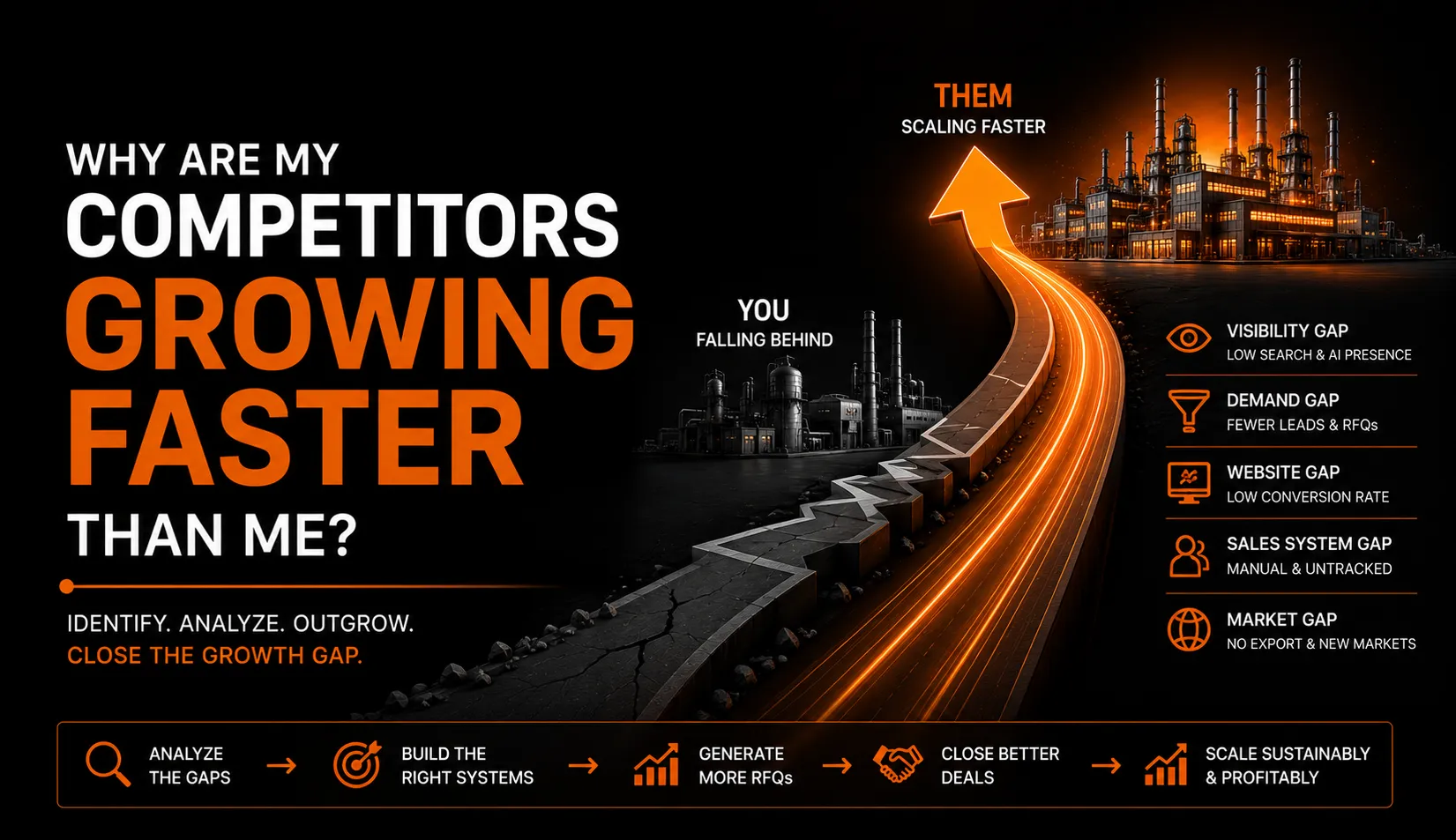
The Five Systems Behind Modern Industrial Growth
Modern industrial growth depends on building a connected digital ecosystem across five key areas:
- —Market visibility across search and AI engines
- —Inbound demand generation
- —Automated sales conversion processes
- —Digital brand credibility
- —Business scalability through Digifacturing
In B2B purchasing, procurement managers shortlist suppliers long before issuing an RFQ. They search Google, ask AI platforms, evaluate a company's factory website, verify ISO certifications, and review technical capabilities. If competitors are visible during this research phase while your company is absent, they start the sales conversation with a massive advantage.
The Manufacturing Growth Equation
Business expansion breaks down into connected operational systems: market visibility leads to website traffic, which leads to qualified leads, which leads to inbound RFQs, which leads to sales conversion, which leads to account retention.
A weakness or gap at any single stage slows down your entire pipeline.
The Ten Growth Gaps
01
Your Competitors Are Easier to Find Online
Most procurement heads begin vendor selection on search engines, using high-intent commercial searches like precision CNC machining supplier, industrial automation company, valve manufacturer in India, OEM sheet metal fabrication, or electrical control panel manufacturer. If competitors consistently rank at the top of Google, they capture qualified RFQs before your sales team even knows an opportunity exists. High-performing factories partner with an industrial SEO agency to execute targeted manufacturing SEO, optimize product specs, build industry landing pages, publish technical articles, and earn authoritative backlinks.
02
They Are Visible in AI Search
Sourcing professionals increasingly ask AI assistants like ChatGPT, Gemini, Claude, and Perplexity which suppliers are reliable for a given part or process. By leveraging AI marketing techniques, competitors publish structured content, schema markups, and case studies that ensure AI tools recommend them over traditional suppliers.
03
Their Factory Website Acts as an Inbound Sales Machine
Many industrial websites still function as digital brochures. High-growth competitors work with a consultant for factory branding and website design to turn their site into a lead capture system, with dedicated industry landing pages, technical product specs and downloadable CAD catalogs, visual proof of scale using drone videography factory tours, displayed quality standards such as ISO, CE, and IATF, client logos, and simple RFQ forms for drawing attachments and volume quotes.
04
They Generate Demand Instead of Waiting for Referrals
Traditional lead sources like word-of-mouth referrals, existing customer re-orders, annual trade exhibitions, and local dealer networks are valuable but difficult to scale. Warning signs include heavy reliance on two or three large accounts, inconsistent monthly inquiry volumes, and no structured inbound lead generation framework. High-growth competitors partner with an industrial marketing agency to run digital marketing across organic search, AI discovery, LinkedIn outreach, Google Ads, and export marketing.
05
They Target Specific Vertical Sectors
Rather than marketing generally, market leaders create specialized content and landing pages for target verticals, including industrial automation, pharmaceutical manufacturing, food processing, automotive, renewable energy, oil and gas, and defense. Structuring digital marketing around specific sectors improves search rankings, messaging relevance, and conversion rates.
06
They Build Technical Authority
Procurement officers prefer working with knowledgeable suppliers. Successful brands regularly publish engineering guides such as how to select valve materials for high-pressure steam lines, process comparisons such as forging versus casting, and technical whitepapers and material checklists. Publishing authoritative content establishes trust long before the first sales call.
07
Their Sales Team Uses Automated RevOps Systems
Growth relies on repeatable processes rather than memory. Winning factories use CRM software, automated lead scoring, pipeline dashboards, and structured RFQ tracking workflows to improve their quotation-to-order conversion rate.
08
They Expand Into Global Export Markets
Winning competitors work with an export buyer marketing specialist to run export marketing campaigns, deploy multilingual landing pages, build global trust, and conduct targeted LinkedIn prospecting in overseas markets.
09
They Track Revenue Performance Drivers
Top-performing manufacturing companies track marketing metrics such as organic traffic, search rankings, AI mentions, and website lead conversions; sales metrics such as monthly RFQs received, quotation-to-order ratio, sales cycle length, and pipeline value; and revenue metrics such as customer acquisition cost, customer lifetime value, and revenue by geography.
10
They Invest in Factory Branding and Authority
Strong brands build buyer trust faster. Working with a manufacturing branding agency to improve factory branding, execute executive LinkedIn thought leadership, and secure AI search citations creates an enduring competitive moat.
Revenue Performance Drivers to Track
01
Marketing Metrics
Organic traffic, search rankings, AI mentions, and website lead conversions.
02
Sales Metrics
Monthly RFQs received, quotation-to-order ratio, sales cycle length, and pipeline value.
03
Revenue Metrics
Customer Acquisition Cost (CAC), Customer Lifetime Value (CLV), and revenue by geography.
Manufacturing Competitor Self-Audit Checklist
Ask yourself these key operational questions:
- —Do we rank on page one of Google for high-intent buyer keywords?
- —Can AI engines like ChatGPT and Gemini cite our plant as a top supplier?
- —Does our website convert traffic into qualified RFQs?
- —Are we regularly publishing technical guides and case studies?
- —Is our sales team active on LinkedIn to reach manufacturing clients?
- —Do we use CRM automation to track quotation follow-ups?
- —Are we actively targeting specific new industrial sectors?
- —Have we launched a structured program for export marketing?
- —Do we track digital customer acquisition metrics?
If you answered no to several of these questions, those exact gaps explain why competitors are expanding faster.
Choosing Your Path: Agency vs. In-House
Building an internal marketing team requires hiring separate specialists for SEO, web design, copyediting, paid ads, and video production. For most growing companies, working with a manufacturing digital transformation consultant provides immediate access to proven playbooks at a fraction of the cost.
If you prefer regional expertise, partnering with a manufacturing consultant in Ahmedabad or Gujarat connects you directly with strategists who understand regional industrial hubs and export dynamics.
How Manufacturing Consultant Helps You Close the Gap
As a dedicated digital marketing partner for factory owners, our team serves as a plant marketing consultant and manufacturer growth consultant. Whether you need a specialized digital marketing manufacturer partner or a manufacturing business growth consultant, we implement Digifacturing frameworks, a complete approach to manufacturing digital transformation that delivers predictable monthly RFQs.
Claim Your Free Competitor Gap Analysis
Book a free 30-minute audit where our team will benchmark:
- —Your search and AI visibility vs. named competitors
- —Website conversion bottlenecks losing you RFQs
- —Technical content and authority gaps
- —Export and new-market growth opportunities
- —A step-by-step roadmap on how to grow a small manufacturing business into an enterprise vendor
Frequently Asked Questions
Commercial
Why are my competitors receiving more manufacturing inquiries?
Competitors capture more inquiries because they invest in manufacturing SEO, AI search optimization, industry-focused content, and conversion-focused websites that position them in front of procurement teams.
Entity
Why do competitors rank higher on Google?
Higher search rankings result from working with an industrial SEO agency, maintaining strong technical site architecture, publishing technical content, earning authoritative backlinks, and building topical authority.
Entity
Can AI Search Optimization help my factory compete?
Yes. AI optimization increases the likelihood that AI tools like ChatGPT, Gemini, Claude, and Perplexity will recommend your plant when buyers ask for supplier recommendations or technical specs.
Commercial
How can factory owners generate export inquiries online?
Export inquiries are generated through international SEO, country-specific landing pages, foreign LinkedIn prospecting, and targeted export buyer marketing campaigns.
Commercial
How long does it take to see results from B2B marketing?
Paid ad campaigns generate inquiries within weeks. Organic strategies like manufacturing SEO and AI search optimization typically deliver measurable RFQ growth within 3 to 6 months.
Stop Losing RFQs to Competitors
Ready to Close the Growth Gap?
Book a free 30-minute Digifacturing Audit with Tarun Gurwara. Walk away with a benchmark of exactly where your competitors are winning and a roadmap to close it.
Ahmedabad, Gujarat, India · Digifacturing · Tarun Gurwara