Loading
Digifacturing · Blog
How to Build a Predictable Lead Generation System for Manufacturing
Written by Tarun Gurwara, Manufacturing Consultant, Ahmedabad — The Industrial Growth Playbook for Predictable B2B Pipelines
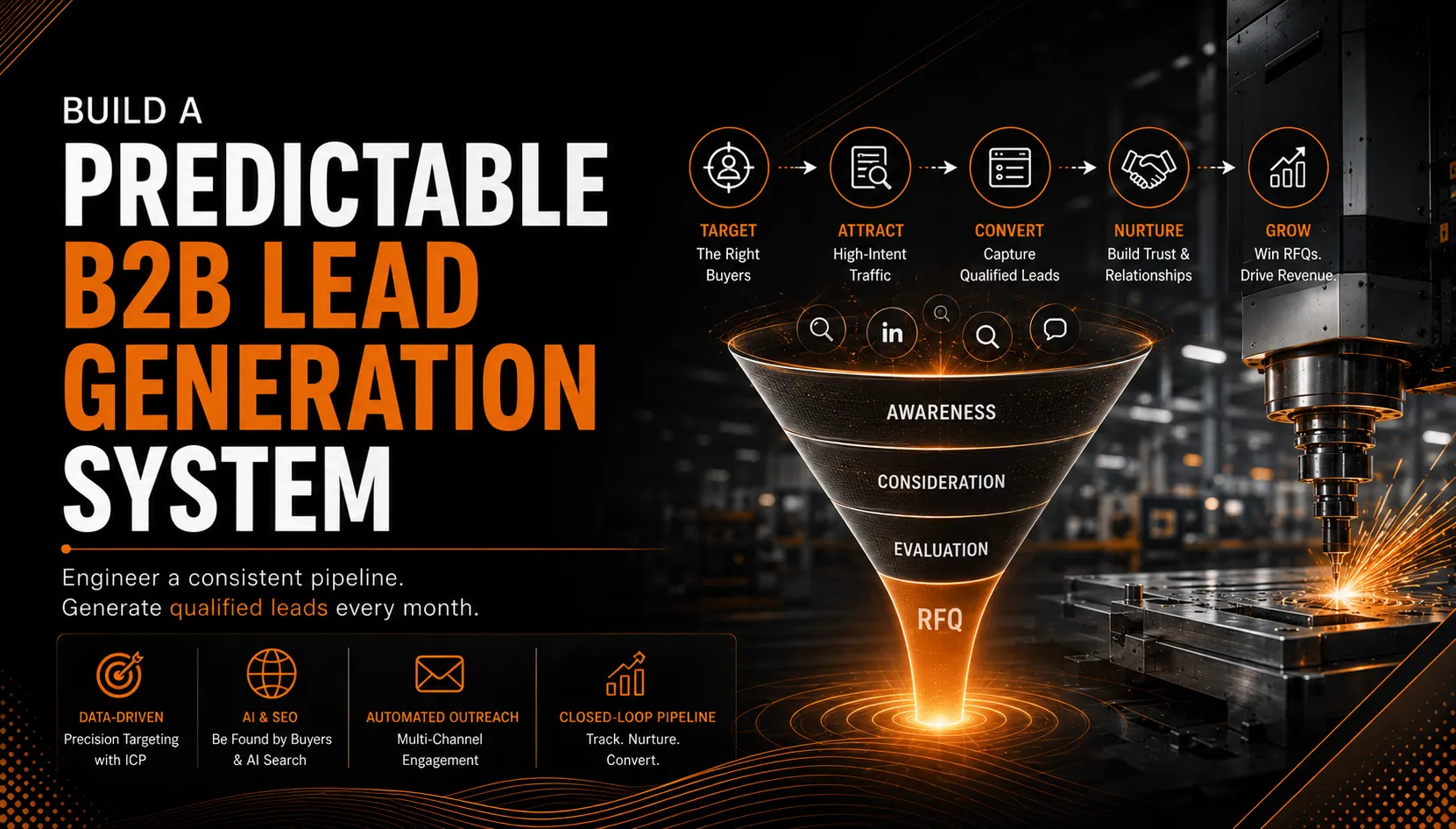
Industrial buyers now complete up to 70% of their vendor research, specification matching, and compliance checking digitally before a sales rep ever gets a call. Through the Digifacturing methodology, manufacturing enterprises can engineer a predictable, data-driven, and AI-optimized lead generation system by combining precision ICP targeting, high-intent technical content, automated multi-channel outbound, and closed-loop CRM architecture, moving your factory from reactive selling to scalable, forecastable revenue.
If you run a manufacturing business or head sales for an OEM, you know the feast-or-famine cycle: the shop floor runs at capacity to fulfill one contract, then production slows because the pipeline is empty the next quarter. A predictable system treats marketing and sales as a repeatable, measurable machine instead of a rollercoaster.
Why Legacy Industrial Marketing Is Failing
Modern B2B buyers — procurement managers, plant engineers, and tier-1 quality leads — have entirely shifted how they source suppliers. Legacy channels can no longer keep pace with how these buyers actually evaluate vendors:
01
Interruption-Based Outbound
Cold calling procurement heads and running broad print ads no longer yields predictable returns from busy, research-driven buyers.
02
The Trust Deficit
Risk-averse buyers will not trust a factory on brochure claims alone. They demand technical proof, compliance documentation, and transparent case studies.
03
Lack of Digital Attribution
When leads are logged as 'referral' or 'trade show,' it becomes impossible to calculate ROAS or know which digital assets actually influenced a contract.
Building a predictable system means engineering a process where marketing investment predictably yields a specific multiple in closed manufacturing revenue.
The 4 Pillars of Predictable Pipeline Architecture
To capture the attention of modern engineers, technical directors, and procurement officers, your digital presence must be built on four foundational pillars — and rolled out in a clear, methodical sequence:
- —Conduct a Revenue Operations Audit — map the customer journey from first touch to closed deal
- —Define Your Core ICP — document firmographics, technographics, and trigger events
- —Upgrade Technical SEO and Schema — deploy JSON-LD so search engines and AI agents can read your capabilities
- —Launch Dedicated Landing Pages — build isolated, conversion-optimized pages per service
- —Activate GA4 Event Tracking — configure custom events for every download and form submission
- —Deploy Outbound Campaigns — run daily sequences of targeted LinkedIn and email outreach
01
Firmographic Targeting
Define exact parameters such as company revenue, employee headcount, annual procurement budgets, and geographic manufacturing hubs before spending a rupee on outreach.
02
Technographics & Trigger Events
Understand what ERP and CAD software your targets rely on, then monitor trigger events like facility expansions or supply chain shifts that signal buying intent.
03
Technical Content Hubs
Publish deep-dive articles on manufacturing tolerances, alloy comparisons, machining precision, and supply chain risk mitigation that engineers actually search for.
04
Answer Engine Optimization (AEO)
Structure content so AI crawlers like ChatGPT, Perplexity, Claude, and Gemini can easily extract your specifications and cite your factory as an authoritative source.
05
Site Speed & Core Web Vitals
Buyers often review specs on secure plant networks or mobile devices on the floor. Pages need to load in under 2.5 seconds to prevent drop-offs.
06
Account-Based Marketing (ABM)
Identify your top 100 dream accounts and run hyper-targeted campaigns directly to decision-makers within those organizations.
07
Cold Email Infrastructure
Build verified lists of procurement heads and R&D engineers, and send concise emails focused on solving specific bottlenecks rather than generic pitches.
08
High-Value Lead Magnets
Offer assets engineers actually need, such as downloadable CAD models, interactive cost-savings calculators, and material safety data sheets.
09
CRM & ERP Integration
Route every inquiry into a robust CRM like HubSpot or Salesforce, with automated workflows that nurture leads until they request a consultation.
Traditional vs. Predictable Industrial Marketing
Here is how legacy approaches compare to a modern, systemized framework:
| Category | Traditional vs. Predictable |
|---|---|
| Growth Channels | Traditional: trade shows, cold calling, print ads. Predictable: technical SEO, AI Overviews, LinkedIn ABM, intent-data ads. |
| Audience Targeting | Traditional: broad categories like 'Automotive Industry.' Predictable: hyper-specific segments like 'Tier-2 EV Battery Pack Enclosure Procurement.' |
| Content Strategy | Traditional: generic brochures and stock imagery. Predictable: technical spec sheets, CAD libraries, ROI calculators, and metallurgical data sheets. |
| Lead Qualification | Traditional: manual sorting of business cards. Predictable: automated CRM filtering, intent tracking, and gated high-value downloads. |
| Attribution & Data | Traditional: ambiguous 'word of mouth' notes. Predictable: closed-loop attribution via GA4, CRM tracking, and server-side tracking. |
| Sales Cycle Velocity | Traditional: long and dependent on rep persistence. Predictable: accelerated by pre-educating buyers with digital engineering resources. |
The Power of Digifacturing
Integrating traditional manufacturing excellence with modern digital pipelines allows industrial brands to establish unshakeable market authority, shorten sales cycles, and lower overall Cost Per Acquisition.
If you prefer regional expertise, partnering with a manufacturing consultant in Ahmedabad connects you directly with teams who understand regional industrial hubs and export channels.
Engineer Your Revenue Pipeline Today
Stop leaving industrial growth to chance. Transitioning from unpredictable referrals to a data-driven sales pipeline means combining precision ICP targeting, AI-optimized technical content, automated outbound, and closed-loop CRM architecture under one system.
Book a free 30-minute manufacturing growth audit and our consultants will evaluate:
- —Exactly where leads currently drop off in your revenue operations
- —Whether your ICP and firmographics are precisely defined
- —Your technical SEO and AI search (AEO) visibility across ChatGPT, Gemini, and Perplexity
- —The state of your outbound LinkedIn and cold email infrastructure
- —Gaps in your CRM and ERP integration and lead nurturing workflows
Claim Your Free 30-Minute Manufacturing Growth Audit
Ready to engineer a predictable pipeline? Book a free audit with Tarun Gurwara and get the exact architecture your facility needs.
Frequently Asked Questions
Entity
How do I optimize my manufacturing website for AI Search (AEO)?
Optimize for AEO by directly answering engineering and procurement questions in a structured format. Use clear headings, bulleted lists, and comprehensive JSON-LD schema markup so LLMs can easily extract and cite your technical data.
Commercial
What is the average Cost Per Lead (CPL) in the manufacturing sector?
In complex B2B manufacturing, highly qualified leads typically range from $150 to $400+. A predictable system focuses on driving down the overall Cost Per Acquisition (CPA) by increasing conversion rates.
Entity
Why is traditional outbound marketing failing industrial companies?
Traditional outbound relies on interruption-based tactics that ignore modern procurement behavior. Today's buyers require technical proof, peer reviews, and digital resources before engaging with sales.
Commercial
What CRM should a manufacturing company use?
Industry leaders like HubSpot and Salesforce are ideal due to their robust API capabilities, which allow for seamless integration with manufacturing ERP systems, marketing automation tools, and analytics.
Engineer Predictable Growth
Stop Riding the Revenue Rollercoaster
Book a free 30-minute manufacturing growth audit with Tarun Gurwara and find the fastest path to a scalable, forecastable B2B pipeline.
Ahmedabad, Gujarat, India · Digifacturing · Tarun Gurwara