Loading
Digifacturing · Lead Generation Consulting
Manufacturing Lead Generation Consultant
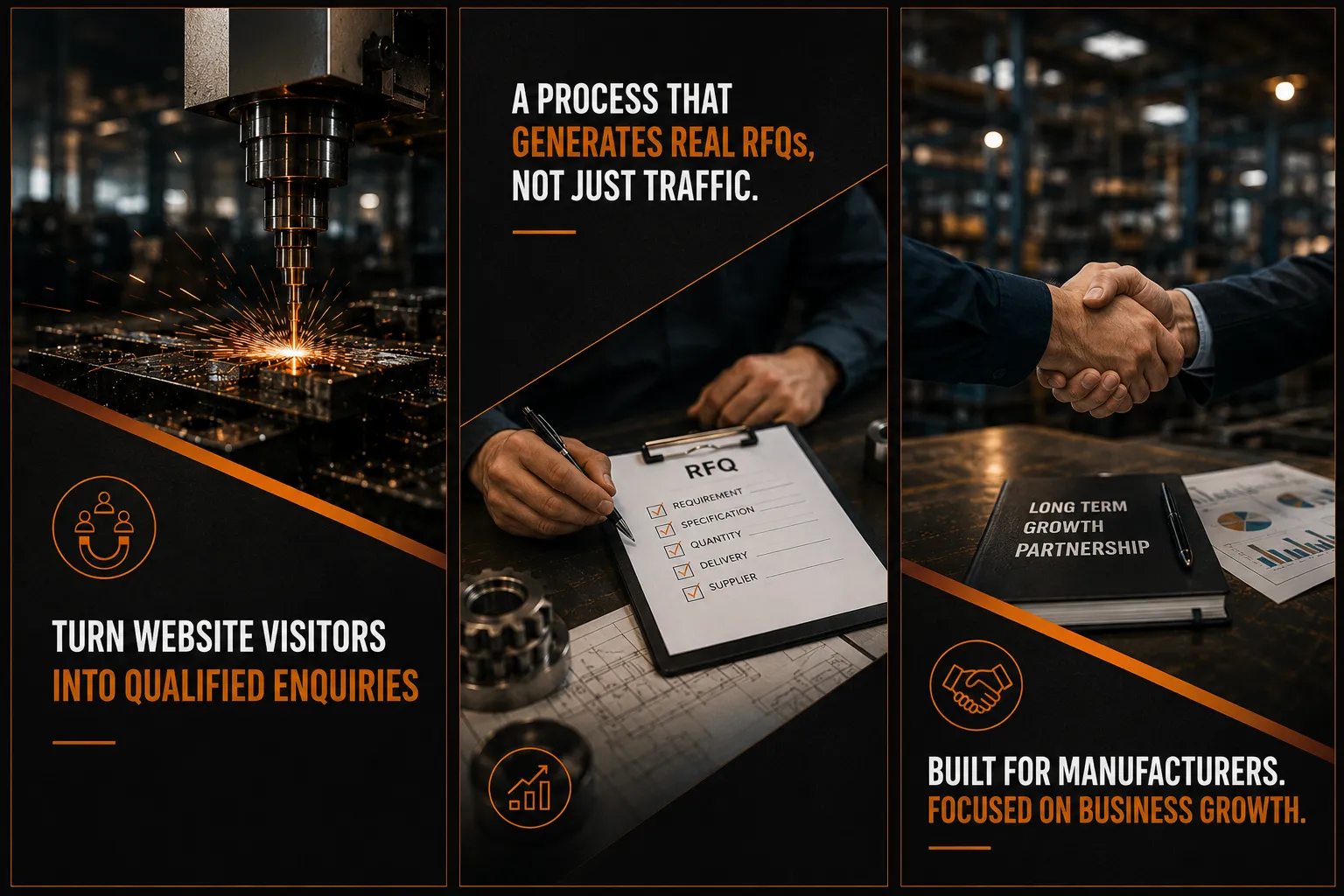
A manufacturing lead generation consultant builds the process that turns industrial buyers into qualified enquiries, OEM leads, RFQs, and export opportunities, rather than just adding website traffic. Tarun Gurwara runs this as a structured five step process under the Digifacturing methodology, built specifically around how manufacturers actually get bought from, not sold to.
Why Traffic Without a Process Doesn't Convert
Most manufacturers already get some visitors to their website. A distributor searches for a supplier, an EPC consultant checks a company profile, a plant head clicks through from LinkedIn. Very few of those visits turn into a real RFQ. The gap is almost always process, not traffic.
A few patterns show up again and again when we look at a manufacturer's current setup:
01
No Clear Ask
The website explains the company well but never actually asks for the enquiry. A visitor has to hunt for a contact number buried in the footer.
02
High Friction Forms
The RFQ form asks for ten fields before a buyer has decided they trust you, so serious buyers abandon it halfway.
03
No Qualification
There is no way to tell a genuine OEM procurement enquiry apart from a student doing a college project, so real leads get lost in the noise.
04
Slow Response
A buyer downloads a brochure or fills a contact form, and then hears nothing back for four or five days, by which point they have already contacted two competitors.
05
Weak Mobile Experience
The site loads slowly on mobile, which is where a growing share of procurement research now happens, especially for export buyers checking from overseas.
None of these are visibility problems. A manufacturer can rank first on Google for the exact right keyword and still lose the enquiry at any one of these points. This page is about what happens once someone actually arrives, since that is usually where the real leak is.
The Five Step Lead Generation Process
1
Business and Buyer Discovery
Understanding your products, your actual buyers, and where your current process loses people. This means sitting down with your sales team, not just your marketing material, because the sales team usually already knows exactly where enquiries go cold. It also means separating your buyer types, since an OEM procurement head, a distributor, and an export trading company all evaluate a supplier differently and often need different information before they act.
2
Website Conversion Audit
Most manufacturing websites are built to describe a company, not convert a visitor. This step goes page by page and checks specific things: how many seconds the site takes to load on a mobile connection, how many fields the RFQ form asks for and whether that number matches how much trust has been built by that point in the page, whether a product page actually leads somewhere or just ends, and whether someone landing from a Google search for a specific product ends up on a page that answers their exact question or a generic homepage that makes them start over.
3
Qualification, Not Just Volume
Setting up the site and outreach so a genuine OEM enquiry doesn't get buried under low intent form fills. In practice this often means adding a short qualifying question to the enquiry form itself, routing enquiries by type so a distributor application and an urgent RFQ don't sit in the same inbox getting the same response time, and setting a target response window, since in industrial buying the first supplier to respond seriously often has a real advantage.
4
Channel Activation
Only once the above is fixed does channel work make sense. Sending more visitors to a site that already leaks them just means losing more people faster. Once the foundation holds up, channel work includes manufacturing SEO and AI search optimization so the right buyers find you organically, targeted LinkedIn outreach aimed specifically at plant heads and procurement teams, and Google Ads built around high intent, application level search terms instead of generic industry keywords.
5
Measurement Against Enquiries
Monthly tracking of actual RFQs, OEM enquiries, and dealer applications, not just traffic or impressions. This includes tracking where each qualified enquiry actually came from, since it is common for a manufacturer to assume Google Ads is driving results when most of the real enquiries are actually arriving through organic search or a LinkedIn conversation that started weeks earlier.
What Actually Counts as a Qualified Manufacturing Lead
Not every enquiry is worth the same. A useful way to sort them:
01
High Intent
A named company, a specific product or specification, and a clear next step requested, such as a quote, a sample, or a plant visit.
02
Medium Intent
General interest from a real business, but no specific product or timeline yet. Worth a follow up, not an immediate quote.
03
Low Intent
Students, competitors, vague form fills with no company detail, or requests for information already published on the site.
A lead generation process that cannot tell these apart tends to either overwhelm a sales team with low value follow ups, or bury the one high intent OEM enquiry that arrived the same day as twenty low intent ones. Sorting this out is often a bigger win than adding a new marketing channel.
Common Mistakes We See Before Working With a Manufacturer
01
Website as Brochure
Treating the website as a brochure instead of a sales tool. A page can be well written and still fail to ask for the enquiry clearly.
02
Slow Responses
Responding to enquiries days later. Industrial buyers often contact more than one supplier at once, and the first serious response frequently has an edge that has nothing to do with price.
03
No Buyer Distinction
No distinction between buyer types. A distributor application, an export enquiry, and a domestic OEM RFQ each need a different response and often a different form, but many sites route all three the same way.
04
Chasing Traffic
Chasing traffic instead of enquiry quality. More visitors to a site that is not set up to convert them just means the same conversion problem happening at a larger scale.
05
No Attribution
Without tracking where a qualified enquiry actually came from, it is easy to keep spending on a channel that looks active but is not the one actually producing RFQs.
Who This Is For
Manufacturers with steady website traffic but low enquiry volume, businesses relying almost entirely on referrals and word of mouth, and exporters trying to build a repeatable pipeline of international buyers rather than one off contacts. See case studies for real examples, including how Axiom Controls moved from an inconsistent enquiry flow to a repeatable process.
Industries this has applied to include industrial controls, pharmaceuticals, food processing, renewable energy, and precision manufacturing, detailed on the industries page.
Start With a Lead Generation Audit
The Digifacturing Audit includes a specific look at where your current enquiry process is losing qualified buyers, before any new channel spend happens.
Get Started
Not sure where your enquiries are actually dropping off? Get a free lead generation audit and find the exact point in your funnel where qualified buyers disappear.
Frequently Asked Questions
Commercial
What does a manufacturing lead generation consultant actually do?
Builds and fixes the process between a visitor arriving on your site and a qualified enquiry reaching your sales team, then layers channel work like SEO, LinkedIn, and Google Ads on top of that fixed foundation.
Entity
Why do manufacturers get traffic but not enquiries?
Usually a conversion problem, not a visibility problem: slow websites, RFQ forms that ask for too much too soon, or no clear next step for a buyer who is genuinely interested.
EntityCommercial
How is this different from just running SEO or Google Ads?
SEO and ads bring visitors. This process is about what happens once they arrive, so that visibility work actually converts instead of leaking through a broken funnel.
GeoCommercial
Can this generate export enquiries specifically?
Yes, when paired with export focused positioning and outreach to international buyers, distributors, and trading companies.
Commercial
How long before this shows results?
Conversion fixes to the website can show improved enquiry quality within weeks. Channel growth on top of that, through SEO and outreach, typically builds over 3 to 6 months.
Entity
Do you work with manufacturers who currently rely only on referrals?
Yes, this is one of the most common starting points. The goal is a repeatable pipeline that doesn't depend entirely on word of mouth.
Entity
How do you tell a qualified OEM enquiry apart from a low intent form fill?
Usually through a short qualifying question added at the point of enquiry, plus routing rules that treat a named company with a specific product request differently from a vague general contact form.
Entity
Does a faster response time actually make a measurable difference?
Yes. Industrial buyers frequently contact more than one supplier at the same time, and the first one to respond seriously often has a real advantage, independent of price or capability.
Commercial
What if our website already gets decent traffic but very few enquiries?
That is the exact pattern this process is built for. The fix is almost never more traffic, it is finding where the existing visitors are dropping off before they ever reach the enquiry form.
EntityCommercial
Do you also help set up how enquiries get routed to our sales team?
Yes. Getting a qualified RFQ to the right person quickly is as much a part of this process as attracting the enquiry in the first place.
Stop Losing Qualified Buyers
Ready to Turn Visitors Into Qualified RFQs?
Book a free 30-minute Digifacturing Audit with Tarun Gurwara. Walk away with a clear picture of where your enquiry process is leaking, and exactly what to fix first.
Ahmedabad, Gujarat, India · Digifacturing · Tarun Gurwara