Loading
Manufacturing Consultant · Manufacturing Lead Generation Blog
How Manufacturers Can Get Leads Without Trade Shows
Manufacturers can replace trade-show dependency with a 365-day lead generation system using SEO, AI search visibility, LinkedIn, and CRM-driven follow-up - generating RFQs every month instead of a few times a year. Here's the framework, the real cost-per-customer math, and the warning signs you're too exhibition-dependent.
Introduction
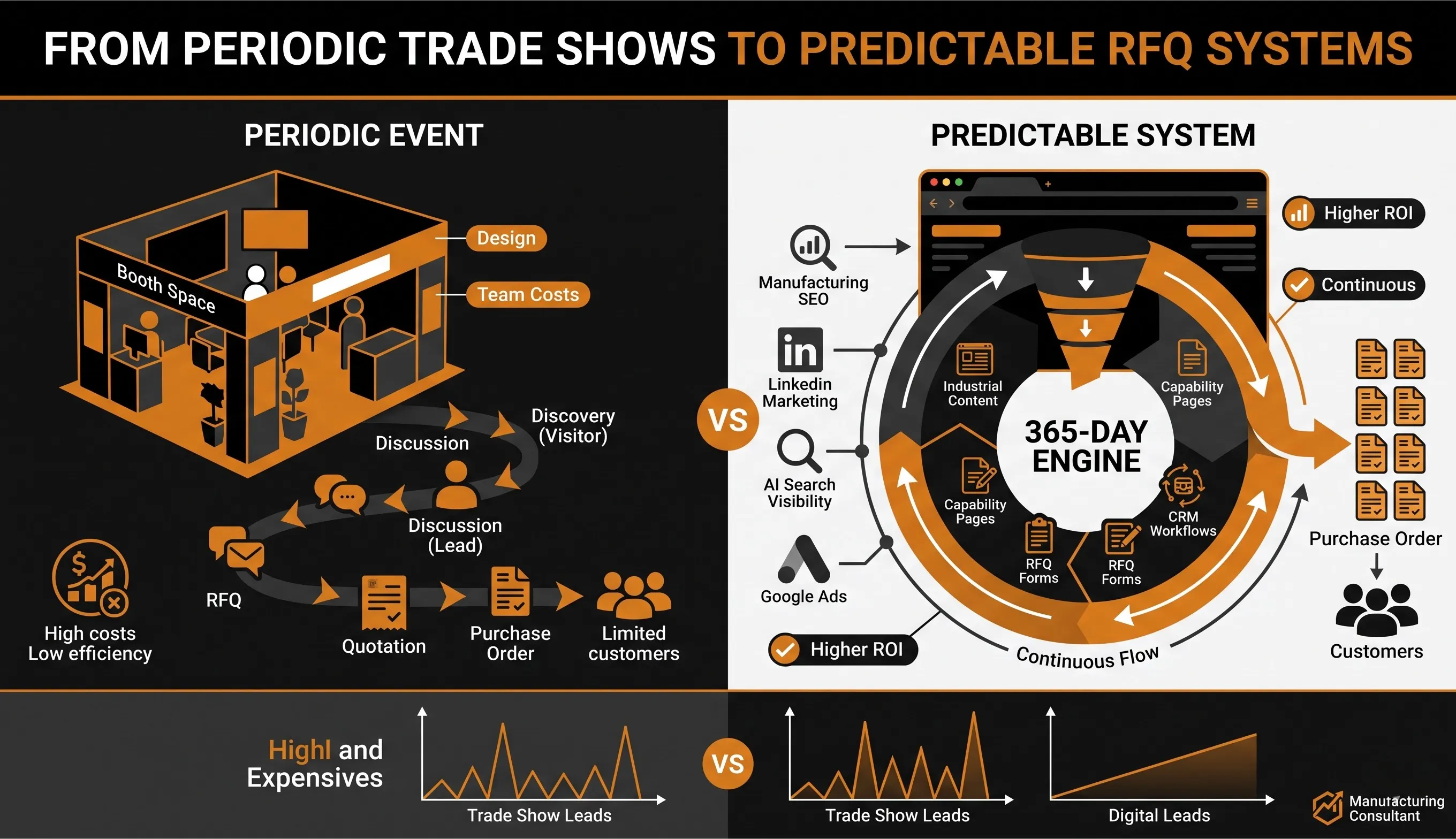
Yes. Manufacturers can generate consistent RFQs without trade shows by building a year-round visibility-to-conversion system: SEO and AI search for discovery, optimized capability pages for conversion, a CRM for qualification, and a sales team focused only on closing.
Trade shows still help with relationships and brand - but they shouldn't be your only lead source. The manufacturers growing fastest today have shifted from event-based lead generation to system-based lead generation.
The Economics of Trade Show Lead Generation
Before discussing alternatives, manufacturers must understand the true cost of trade-show-generated leads. Most companies calculate booth rental, travel, accommodation, and display materials - but rarely calculate cost per visitor, cost per lead, cost per RFQ, cost per quotation, or cost per customer acquired.
Consider a typical trade show investment: booth space at ₹3,00,000, stall design at ₹2,00,000, travel and stay at ₹1,50,000, marketing material at ₹50,000, and team costs at ₹1,00,000 - totalling ₹8,00,000. That investment typically yields 400 visitors, 100 discussions, 25 RFQs, and 5 customers.
₹8,00,000 ÷ 5 customers = ₹1,60,000 customer acquisition cost. Most manufacturers never calculate this figure.
Why Industrial Buyers No Longer Depend on Trade Shows
The industrial procurement process has fundamentally changed. Ten years ago, the buyer journey moved from trade show to supplier discovery to RFQ to purchase order. Today, buyers search Google and AI tools, research on LinkedIn, review supplier websites and case studies, conduct technical evaluation, and only then submit an RFQ.
By the time a buyer contacts a supplier, supplier shortlisting has often already happened. This means visibility before the RFQ stage is now critical.
Most manufacturers focus only on the final conversion stage. The first three stages - visibility, lead capture, and lead qualification - are often missing entirely.
The Manufacturing Lead Generation Framework
When we design growth systems for manufacturers, we focus on four stages: Visibility → Lead Capture → Lead Qualification → Sales Conversion. Here is what each stage requires:
01
Stage 1: Building Visibility Where Buyers Search
Industrial buyers search with commercial intent - terms like 'CNC machining company in India', 'precision turned components supplier', or 'sheet metal fabrication company'. These are sourcing searches, not information searches. If your company does not rank for these keywords, competitors receive the RFQs. AI search optimization is equally critical: manufacturers that fail to create expert content risk becoming invisible in AI-generated supplier recommendations. On LinkedIn, procurement professionals evaluate company activity, industry expertise, technical content, and management credibility before initiating contact.
02
Stage 2: Converting Traffic into RFQs
Many manufacturers focus on traffic but very few focus on conversion. A visitor becomes valuable only when they become an inquiry. High-performing manufacturing websites include dedicated capability pages for CNC Machining, Fabrication, Tool Room, and Injection Molding; industry pages for Automotive, Aerospace, Medical, and Industrial Equipment; and downloadable assets such as company profiles, capability decks, product catalogs, and certification documents. Missing RFQ forms, generic contact pages, and weak trust signals are the most common conversion failures.
03
Stage 3: Lead Qualification Systems
Not every inquiry is a business opportunity. Effective qualification frameworks assess technical fit (can the product be manufactured?), commercial fit (does order value justify effort?), capacity fit (can delivery requirements be met?), and strategic fit (does the customer align with long-term objectives?). A CRM should track the full pipeline from inquiry received through qualified, RFQ submitted, quotation sent, negotiation, and order won or lost. Without visibility into this process, scaling becomes difficult.
04
Stage 4: Converting RFQs into Customers
This stage cannot be fully automated - sales teams remain critical. However, their role changes. Instead of searching for prospects, they focus on technical discussions, application engineering, quotation optimization, negotiations, and relationship management. When visibility, capture, and qualification are handled systematically, the sales team dramatically improves productivity by focusing exclusively on closing.
The 365-Day Lead Generation Engine
The most successful manufacturers no longer rely on periodic events. They build systems that generate demand continuously. This engine combines four integrated components.
Traffic Sources include manufacturing SEO, LinkedIn, Google Ads, AI Search, and email marketing. Conversion Systems include landing pages, RFQ forms, and capability profiles. Sales Systems include CRM, follow-up workflows, and lead scoring. Analytics Systems track RFQs generated, cost per RFQ, RFQ-to-order ratio, and revenue attribution.
Instead of waiting for the next exhibition, manufacturers invest in SEO, AI search visibility, LinkedIn marketing, RFQ conversion systems, CRM workflows, and sales process optimization. The result is a pipeline that generates opportunities every month, not just during trade show season.
Warning Signs That You Are Too Dependent on Trade Shows
During consulting engagements, we identify three patterns that indicate dangerous exhibition dependency:
1
Warning Sign: Lead Source Concentration
More than 50% of leads come from exhibitions, less than 10% of inquiries come from organic search, and there is no LinkedIn lead generation process or content marketing strategy in place. This creates a growth model that is entirely dependent on periodic events rather than a continuous system.
2
Warning Sign: No Measurement Infrastructure
No CRM implementation exists, no monthly RFQ targets are set, and no lead source tracking is in place. Without this data, manufacturers cannot identify whether their growth challenges are caused by visibility, conversion, or qualification failures.
3
Warning Sign: No System-Based Lead Generation
The company has no structured process to generate demand between trade shows. Traffic sources, conversion systems, sales workflows, and analytics are all missing or disconnected. The result is unpredictable lead flow and revenue that is difficult to forecast or scale.
How Manufacturing Consultant Helps Manufacturers Build Lead Generation Systems
Unlike traditional marketing agencies, we focus specifically on manufacturing buyer acquisition. Our process begins with a visibility audit covering SEO analysis, competitor benchmarking, and search opportunity mapping.
We then design the lead generation system including keyword strategy, industry landing pages, RFQ funnels, and LinkedIn systems. We optimize the sales process through CRM setup, lead qualification frameworks, and follow-up workflows. Finally, we implement growth measurement tracking cost per lead, cost per RFQ, RFQ conversion rates, and revenue attribution.
Our objective is not simply increasing traffic. Our objective is creating a measurable system that generates qualified business opportunities throughout the year - so growth becomes predictable, scalable, and less dependent on any single event.
Recognize 2 or More of These Warning Signs in Your Pipeline?
Connect with Tarun Gurwara and book a free lead-source audit - we'll map exactly where your RFQs are coming from today and where you're losing them.
Frequently Asked Questions
EntityCommercial
How can manufacturers generate RFQs without trade shows?
Manufacturers can generate RFQs through SEO, LinkedIn outreach, AI search visibility, industry-specific content, Google Ads, and optimized website conversion systems.
EntityCommercial
What is the best lead generation channel for manufacturing companies?
The most effective channel depends on the industry, but manufacturing SEO often delivers the highest long-term ROI because it captures buyers actively searching for suppliers.
EntityGeo
Why do manufacturing websites fail to generate inquiries?
Common reasons include poor SEO, weak trust signals, lack of technical content, missing RFQ forms, and ineffective conversion paths.
EntityCommercial
Can LinkedIn generate industrial buyers?
Yes. LinkedIn allows manufacturers to connect directly with procurement managers, sourcing heads, plant managers, and decision-makers across industries.
Commercial
What KPIs should manufacturers track for lead generation?
Key metrics include organic traffic, RFQs generated, qualified leads, cost per RFQ, RFQ-to-order conversion rate, and customer acquisition cost.
EntityGeo
Should manufacturers stop attending trade shows?
No. Trade shows should complement a lead generation strategy, not be the sole source of business development. They remain valuable for networking, relationship building, and brand visibility.
Entity
What is the real cost of trade show lead generation?
Most manufacturers calculate booth rental, travel, accommodation, and display materials - but never calculate cost per visitor, cost per lead, cost per RFQ, or cost per customer acquired. A typical ₹8,00,000 trade show investment generating 5 customers equals ₹1,60,000 per customer acquisition.
EntityCommercial
What does a 365-day lead generation engine look like for manufacturers?
It combines traffic sources (SEO, LinkedIn, Google Ads, AI Search, Email Marketing), conversion systems (landing pages, RFQ forms, capability profiles), sales systems (CRM, follow-up workflows, lead scoring), and analytics systems (RFQs generated, cost per RFQ, RFQ-to-order ratio, revenue attribution).
GeoCommercial
How does Manufacturing Consultant help manufacturers build lead generation systems?
Manufacturing Consultant conducts a visibility audit covering SEO analysis, competitor benchmarking, and search opportunity mapping, then designs lead generation systems including keyword strategy, industry landing pages, RFQ funnels, and LinkedIn systems, and optimizes the sales process through CRM setup, lead qualification frameworks, and follow-up workflows.
Start Generating Direct Leads Today
Ready to Build a 365-Day Manufacturing Lead Generation Engine?
Book a free 30-minute Lead Source Audit with Tarun Gurwara. In 30 minutes, you will walk away with a clear map of where your RFQs are coming from today, where you are losing them, and exactly what to build next to generate consistent inquiries every month.
Ahmedabad, Gujarat, India · Manufacturing Consultant · Tarun Gurwara