Loading
Digifacturing · Manufacturing Digital Marketing Guide
Digital Marketing for Manufacturing Companies in India: A Complete Guide to Generating RFQs
How digital marketing works specifically for Indian manufacturing companies - covering manufacturing SEO, technical content, LinkedIn outreach, paid search, AI-powered marketing, and RFQ generation systems. Written for plant owners, business development heads, and marketing managers who want qualified industrial enquiries, not just website traffic.
What Is Digital Marketing for Manufacturing Companies?
Digital marketing for manufacturing companies is a set of coordinated online activities - including manufacturing SEO, technical content, LinkedIn outreach, targeted paid search, and structured lead nurturing - designed specifically around long B2B buying cycles to generate RFQs, OEM enquiries, and export leads.
It is fundamentally different from consumer digital marketing. Industrial buyers - procurement managers, quality engineers, sourcing heads, plant directors - do not respond to promotional ads or viral content. They evaluate suppliers over weeks or months, loop in multiple departments, and need technical documentation to justify supplier selection internally. Digital marketing for manufacturers must be built around that reality.
Why Most Indian Manufacturers Fail at Digital Marketing
Most manufacturing companies that invest in digital marketing apply consumer marketing logic to an industrial context. The result is a digital presence that looks active but generates no qualified enquiries. The core reasons for failure:
01
Wrong Success Metrics
Many manufacturers measure digital marketing performance through website traffic, social media followers, impressions, and click-through rates. These numbers reflect activity, not business outcomes. The only metric that matters for a manufacturer is qualified RFQs.
02
No Manufacturing SEO
Industrial buyers search Google using highly specific technical terms - "precision sheet metal fabrication India," "IATF-certified auto component supplier Maharashtra," "custom CNC machined parts OEM." If a manufacturer does not rank for these terms, they are invisible before the buyer ever reaches the company website.
03
Weak Technical Content
Most manufacturing websites contain only basic product descriptions and company profiles. Industrial buyers need specifications, tolerances, certifications, process capabilities, quality documentation, and application case studies to evaluate a supplier. Without this content, buyers move to competitors who provide greater transparency.
04
No Structured Lead Nurturing
An industrial buying cycle spans 6 to 18 months. A buyer who visits a website today may not be ready to issue an RFQ for six months. Without a structured follow-up system, that enquiry goes cold and the opportunity is lost.
05
Agency Mismatch
Most digital marketing agencies are built for e-commerce or local services. They lack understanding of industrial procurement, OEM buying behaviour, and the technical content requirements of the manufacturing sector.
How Industrial Buyers Research Suppliers Online
Understanding the industrial buying journey is essential for building digital marketing that actually generates RFQs. Effective digital marketing maps content, SEO, and lead generation to every stage of this journey.
Stage 1Problem Identification
The buyer identifies a requirement - sourcing a new supplier, reducing component costs, qualifying a backup vendor, or expanding to a new geography.
Stage 2Online Research
The buyer searches Google, LinkedIn, industry portals (IndiaMart, TradeIndia, Thomasnet), and supplier directories. This is where manufacturing SEO determines visibility.
Stage 3Supplier Shortlisting
Potential suppliers are evaluated on technical capabilities, certifications (ISO, IATF, AS9100, BIS), production capacity, geographic proximity, industry experience, and website quality.
Stage 4Internal Validation
The procurement team consults engineering, quality, operations, and finance before issuing an RFQ. Technical content, factory proof, and third-party certifications are critical at this stage.
Stage 5RFQ Submission
Only a small number of suppliers receive RFQs. The companies that provide the most confidence and technical transparency during the evaluation process are typically shortlisted.
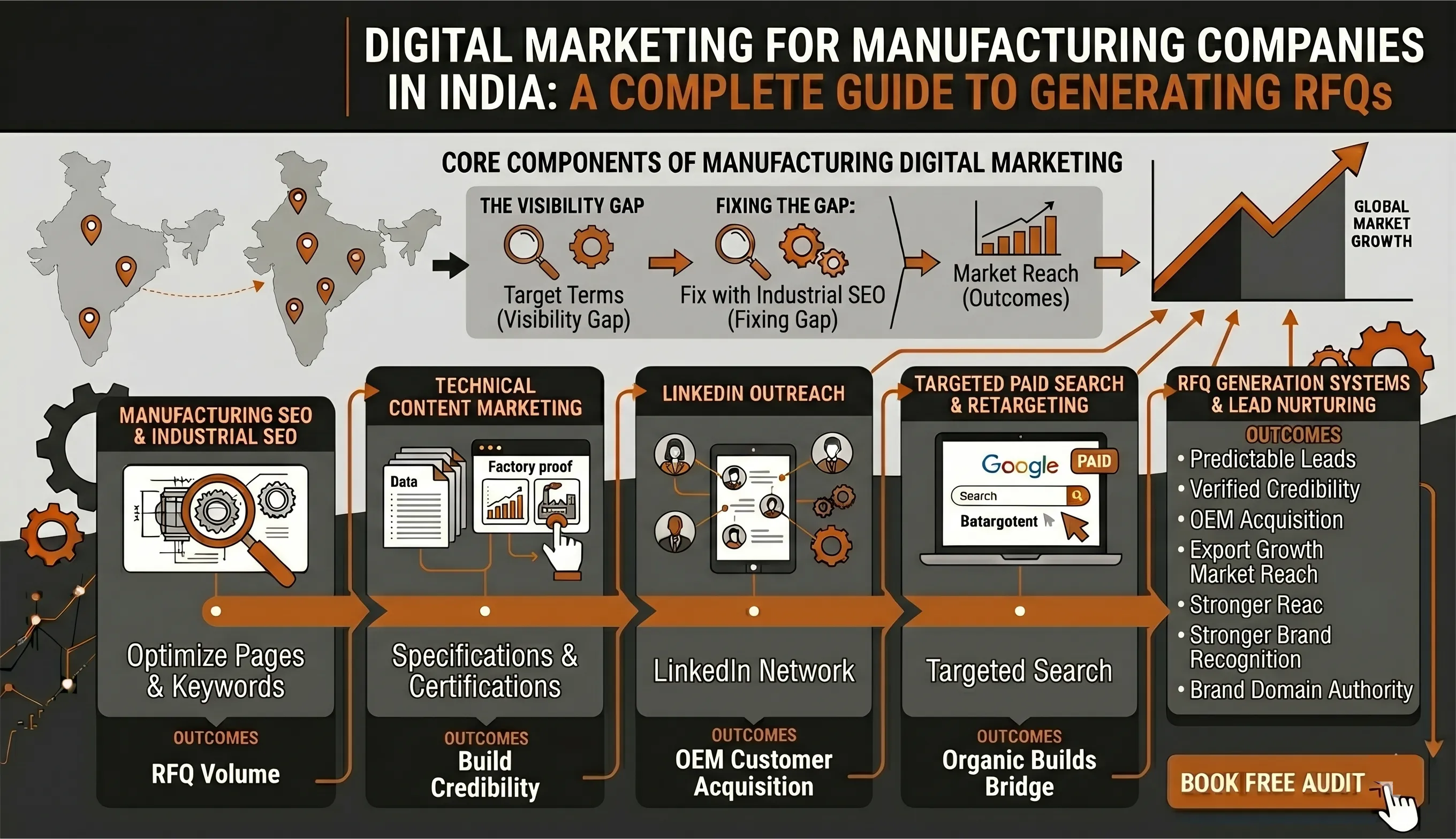
Core Components of Manufacturing Digital Marketing
01
Manufacturing SEO and Industrial SEO
Manufacturing SEO is the process of ranking a manufacturer's website on Google for the specific, technical search terms industrial buyers use when evaluating suppliers. It requires identifying buyer-intent keywords at the product, process, and application level; building dedicated pages for each capability, industry served, and certification held; optimising for long-tail technical queries with high purchase intent; and earning backlinks from industry directories, trade publications, and certification bodies.
Manufacturing SEO is the foundation. Every other channel - content, LinkedIn, paid search - builds on the organic visibility it creates.
02
Technical Content Marketing
Technical content serves two functions simultaneously: it improves organic search rankings, and it provides the evidence industrial buyers need to advance a supplier through their internal evaluation process. Effective content types include product and process specification pages, application guides and industry use cases, certification and compliance documentation, factory capability overviews with process imagery, RFQ-ready data sheets, and case studies with measurable outcomes.
Generic blog content - "5 reasons to choose a quality manufacturer" - has no place in industrial digital marketing. Every content asset should answer a question an industrial buyer has during their evaluation process.
03
LinkedIn Outreach
LinkedIn is where most Indian industrial buyers are professionally active. Procurement managers, sourcing heads, plant directors, and OEM vendor development teams maintain professional profiles and respond to relevant supplier outreach. LinkedIn outreach for manufacturers involves building a credible company page with capability evidence, targeted connection and outreach to procurement and engineering decision-makers, sharing technical content that establishes domain authority, and direct messaging sequences built around specific capability or certification strengths.
04
Targeted Paid Search and Retargeting
Manufacturing SEO compounds over time, but takes 3 to 6 months to show meaningful visibility gains. Paid search on Google - targeted at buyer-intent keywords - can generate enquiries faster while organic visibility builds. Retargeting is particularly important in manufacturing: because industrial buying cycles span months, a buyer who visits a website once and leaves may be ready to issue an RFQ six months later. Retargeting ads keep the supplier visible across that entire window.
Paid channels should be treated as a bridge, not a permanent substitute for organic visibility.
05
RFQ Generation Systems and Lead Nurturing
Generating a website visit or an initial enquiry is only the first step. A structured lead nurturing system - email sequences, targeted content delivery, and timely follow-up - keeps the supplier top-of-mind across the full buying cycle. Key elements include clear calls to action on every product and capability page, downloadable spec sheets gated behind a contact form, automated email sequences sending relevant technical content at defined intervals, lead scoring that prioritises enquiries by industry fit and volume, and CRM integration so sales teams see full buyer history before making contact.
AI Marketing for Manufacturers: What It Actually Does
AI marketing tools are increasingly relevant for manufacturing companies, but the term is used loosely. Here is what AI concretely contributes in an industrial context:
01Scaled Technical Content Creation
AI tools can turn existing specifications, certifications, process documentation, and CAD data into structured product pages, application guides, and capability explainers faster than a manual content team. This is particularly valuable for manufacturers with large, complex product ranges.
02Automated Lead Qualification
AI-powered lead scoring systems can automatically evaluate inbound enquiries by industry segment, geography, order volume, and application fit - so sales teams spend time on the RFQs worth pursuing, not every web form submission.
03Personalised Nurturing at Scale
AI enables different follow-up content to be delivered to different buyer segments - a first-time OEM enquiry receives different information than a returning export buyer - without manually building that logic for every segment.
What AI does not do: Replace the technical credibility built through real certifications, factory evidence, and industry experience. AI scales the marketing motion. It does not manufacture supplier trust.
Consumer Digital Marketing vs. Industrial Digital Marketing
Dimension
Consumer
Industrial
Decision Cycle
Minutes to days
3 to 18 months
Number of Decision-Makers
Usually one
Procurement, engineering, quality, finance
Primary Success Metric
Clicks, ROAS, conversions
Qualified RFQs, OEM enquiries
Trust Signals That Matter
Reviews, social proof
Certifications, factory evidence, case studies
Content That Converts
Ads, offers, brand narrative
Specifications, compliance documents, technical proof
Channel Priority
Social media, display ads
SEO, LinkedIn, targeted paid search
Manufacturing Digital Transformation: Visibility Is the Missing Component
Digital transformation in manufacturing is most often discussed in terms of automation, Industry 4.0, smart factories, ERP integration, and connected production systems. The component most manufacturers overlook is digital visibility.
A factory can have advanced production capabilities, AS9100 certification, IATF compliance, and world-class infrastructure - and still lose business to competitors with inferior capabilities but stronger online presence, because industrial buyers cannot find them.
Digital marketing is the bridge between operational excellence and market visibility. When manufacturers combine manufacturing SEO, technical content, structured lead generation, and AI-powered marketing, they create a digital infrastructure that supports sustainable business growth - not a short-term campaign.
Realistic Timelines: What to Expect
Manufacturing digital marketing is not a switch. Results build over time. Manufacturers who expect immediate RFQ volume from organic SEO and content will be disappointed. Those who commit to a 12-month programme build a lead generation system that operates continuously.
0–3 MonthsFoundation
Website optimisation, technical content creation, keyword research, and SEO foundation work. Paid search and LinkedIn outreach can generate initial enquiries in this period.
3–6 MonthsVisibility Gains
Manufacturing SEO begins showing measurable ranking improvements for target keywords. Organic traffic from industrial buyer searches increases. Lead nurturing sequences activate on earlier enquiries.
6–12 MonthsPipeline Builds
Organic visibility compounds. RFQ volume from inbound search builds. The combination of SEO, content, paid search, and nurturing creates a consistent pipeline rather than ad hoc enquiries.
12+ MonthsCompounding Asset
Organic visibility becomes a durable business asset. Paid spend can be reduced or redirected as SEO carries more of the lead generation load.
Common Digital Marketing Mistakes Manufacturing Companies Make
◆Treating the Website as a Digital Brochure
A manufacturing website should function as a 24/7 sales asset - generating enquiries, qualifying buyers, and providing the technical evidence needed to advance supplier evaluation. A static company profile does none of this.
◆Ranking Only for the Company Name
If a manufacturer only appears on Google when buyers search for the company name, they are invisible to buyers who do not already know them. Manufacturing SEO targets the technical search terms buyers use before they have identified a supplier.
◆Publishing Generic Marketing Content
Industrial buyers have no use for content that does not advance their supplier evaluation. Every content asset should answer a specific technical question a buyer has during the research or validation stage.
◆Measuring Traffic Instead of RFQs
A manufacturer with 500 monthly website visitors and three qualified RFQs is generating more business value than one with 5,000 visitors and no enquiries. Traffic is not a proxy for pipeline.
◆Treating Digital Marketing as a One-Time Project
Industrial buyers are always in some stage of their evaluation cycle. Digital marketing needs to be continuously active to capture buyers at each stage, year-round.
◆Not Tracking Which Channels Generate the Best Enquiries
Without lead source tracking, manufacturers cannot identify which channels deliver the highest-quality RFQs and cannot allocate budget accordingly.
How to Choose a Digital Marketing Partner for Manufacturing
Most digital marketing agencies do not understand industrial procurement. Before engaging a partner, evaluate them on five criteria:
01
Manufacturing-Specific Experience
Industrial sales operate on different timelines, involve multiple decision-makers, and require technical content expertise. General digital marketing experience does not transfer. Ask for examples of manufacturing clients specifically.
02
RFQ-Focused Reporting
Any agency proposing to measure success through impressions, likes, or generic traffic does not understand the industrial context. The reporting framework should be built around qualified enquiries and RFQ volume.
03
Understanding of OEM and Long-Cycle B2B Buying
A 6 to 18 month decision window requires a fundamentally different nurturing approach than a same-day retail purchase. Confirm that the partner has designed campaigns around long B2B cycles.
04
Manufacturing SEO Capability
Ranking for technical, buyer-intent search terms is the foundation of industrial digital marketing. Confirm that manufacturing and industrial SEO are core capabilities, not general SEO applied to a manufacturing client.
05
Verifiable Results from Manufacturing Clients
Ask for specific outcomes - RFQ volume, organic ranking improvements for technical search terms, enquiry quality - from current or past manufacturing clients. Portfolio work from unrelated sectors does not predict performance in this context.
Business Outcomes of Manufacturing Digital Marketing
When implemented correctly and sustained over 12 months, digital marketing for manufacturing companies delivers:
◆
Increased inbound RFQ volume from buyers actively researching suppliers
◆
Improved OEM customer acquisition through better visibility with procurement teams
◆
Stronger export market reach and enquiries from international buyers
◆
Reduced dependency on trade exhibitions and referral networks
◆
Improved sales efficiency - sales teams engage qualified opportunities rather than cold prospects
◆
Sustainable lead generation that operates year-round, not only around exhibition cycles
◆
Better marketing ROI as organic visibility compounds over time
Ready to Build a Digital Marketing System That Generates RFQs?
Connect with Tarun Gurwara and book a free 30-minute Digifacturing audit for your manufacturing business.
Frequently Asked Questions
EntityCommercial
What is digital marketing for manufacturing companies?
Digital marketing for manufacturing companies is a coordinated set of online activities - manufacturing SEO, industrial SEO, technical content marketing, LinkedIn outreach, targeted paid search, and lead nurturing - designed around long B2B buying cycles to generate qualified RFQs, OEM enquiries, and export leads from industrial buyers.
EntityCommercial
What does AI marketing for manufacturers actually involve?
AI marketing for manufacturers involves using AI tools for scaled technical content creation, automated lead qualification by industry fit and volume, and personalised nurturing sequences that deliver relevant content to different buyer segments across a 6 to 18 month decision window.
EntityCommercial
Which digital marketing channels generate the most RFQs for manufacturers?
Manufacturing SEO and technical content produce the most consistent and compounding RFQ volume over time. LinkedIn outreach and targeted paid search generate enquiries faster and work best as a bridge while organic SEO builds long-term visibility.
Commercial
How long does it take to see results from manufacturing digital marketing?
Manufacturing SEO and content typically show ranking improvements in 3 to 6 months. Meaningful RFQ volume from organic search builds over 6 to 12 months. Paid search and LinkedIn can generate earlier enquiries. A 12-month commitment is the minimum for building a sustainable lead generation system.
EntityCommercial
How do I choose the right digital marketing partner for my manufacturing business?
Evaluate any partner on five criteria: manufacturing-specific experience, RFQ-focused reporting (not vanity metrics), understanding of long OEM buying cycles, genuine manufacturing SEO capability, and verifiable results from manufacturing clients.
Start Generating Direct Leads Today
Ready to Build a Predictable Manufacturing Sales Pipeline?
Book a free 30-minute Manufacturing Growth Audit with Tarun Gurwara. Walk away with a clear picture of where your manufacturing business stands digitally - and exactly what to do next to generate more RFQs.
Ahmedabad, Gujarat, India · Virtual Pebbles · Tarun Gurwara