Loading
Manufacturing Consultant · Manufacturing Sales & Marketing Blog
Can Digital Marketing Replace a Manufacturing Sales Team?
No - digital marketing for manufacturing companies doesn't replace a sales team, it replaces the inefficient part of the sales process. Done right, digital marketing becomes your outbound sales team's inbound engine: it generates RFQs, qualifies buyers before first contact, and feeds a structured sales funnel - while your sales team focuses on technical discussions, negotiation, and closing.
Introduction
At Digifacturing, one question comes up in almost every strategy conversation with manufacturing business owners: "If we invest in SEO, LinkedIn marketing, Google Ads, and manufacturing lead generation, do we still need a sales team?"
It's a fair question. Working with manufacturers across engineering, machining, fabrication, plastics, industrial equipment, chemicals, and export sectors, we've seen companies spend heavily on sales teams while generating very few real opportunities. We've also seen manufacturers generate hundreds of inquiries through online lead generation and still struggle to convert them into customers.
Our experience is consistent: digital marketing for manufacturing companies does not replace a manufacturing sales team.
What it replaces is the inefficient, manual, low-leverage part of the sales process - prospecting, cold outreach, and directory searching. Manufacturers who treat marketing and sales as one connected system consistently outgrow those who treat them as separate departments.
What We See During Manufacturing Sales Audits
When we audit a manufacturing company's sales process, we typically find one of three situations:
1
Scenario 1: Strong Sales Team, Weak Lead Flow
Experienced sales professionals, but the website generates little traffic, no SEO or industrial marketing strategy exists, LinkedIn presence is weak, and there's no export lead system. The sales team spends its time hunting for opportunities instead of closing them.
2
Scenario 2: Strong Marketing, Weak Conversion
Inquiries flow in through the website, LinkedIn, Google Ads, and B2B platforms - but leads aren't qualified, follow-up is inconsistent, quotations are delayed, and no CRM exists to manage the pipeline.
3
Scenario 3: No Structured Growth System
The most common situation. Marketing and sales operate independently. Management tracks revenue but not the sales funnel stages that produce it. Growth becomes unpredictable.
The Real Role of Digital Marketing in Manufacturing
Many manufacturers assume digital marketing is just another form of advertising. In reality, it's a demand-generation system built on inbound marketing principles - ensuring buyers discover your company before they discover your competitors.
Done correctly, digital marketing for manufacturing companies improves search visibility, builds buyer credibility, generates qualified RFQs, reaches export customers, and reduces dependence on cold outbound sales activity.
What it doesn't do: negotiate contracts, resolve technical queries, or build long-term customer relationships. Marketing generates opportunities. Sales converts them into revenue.
Related reading: Digital Marketing for Manufacturing Companies and Why Manufacturing Companies Struggle to Generate Sales Leads.
Which Sales Activities Can Digital Marketing Replace?
Ten years ago, buyers found suppliers through trade fairs, directories, and references. Today they search through Google, LinkedIn, and AI search tools. If you're visible online, buyers can discover you without a salesperson making the first call - this is the foundation of effective industrial lead generation.
Many sales teams spend hours prospecting, finding contact details, sending cold emails, and making introductory calls. A strong manufacturing SEO and online lead generation strategy brings qualified prospects directly to your website instead, cutting prospecting costs significantly. See How Manufacturers Can Get Leads Without Trade Shows and Beyond IndiaMART: Manufacturing Lead Generation.
A properly structured manufacturing website should answer: which industries you serve, what capabilities and certifications you hold, your production capacity, export experience, and quality standards - letting prospects self-qualify before ever contacting you. If your site isn't doing this yet, start here: How to Improve Your Website for Industrial Buyers.
The Manufacturing Growth Framework We Recommend
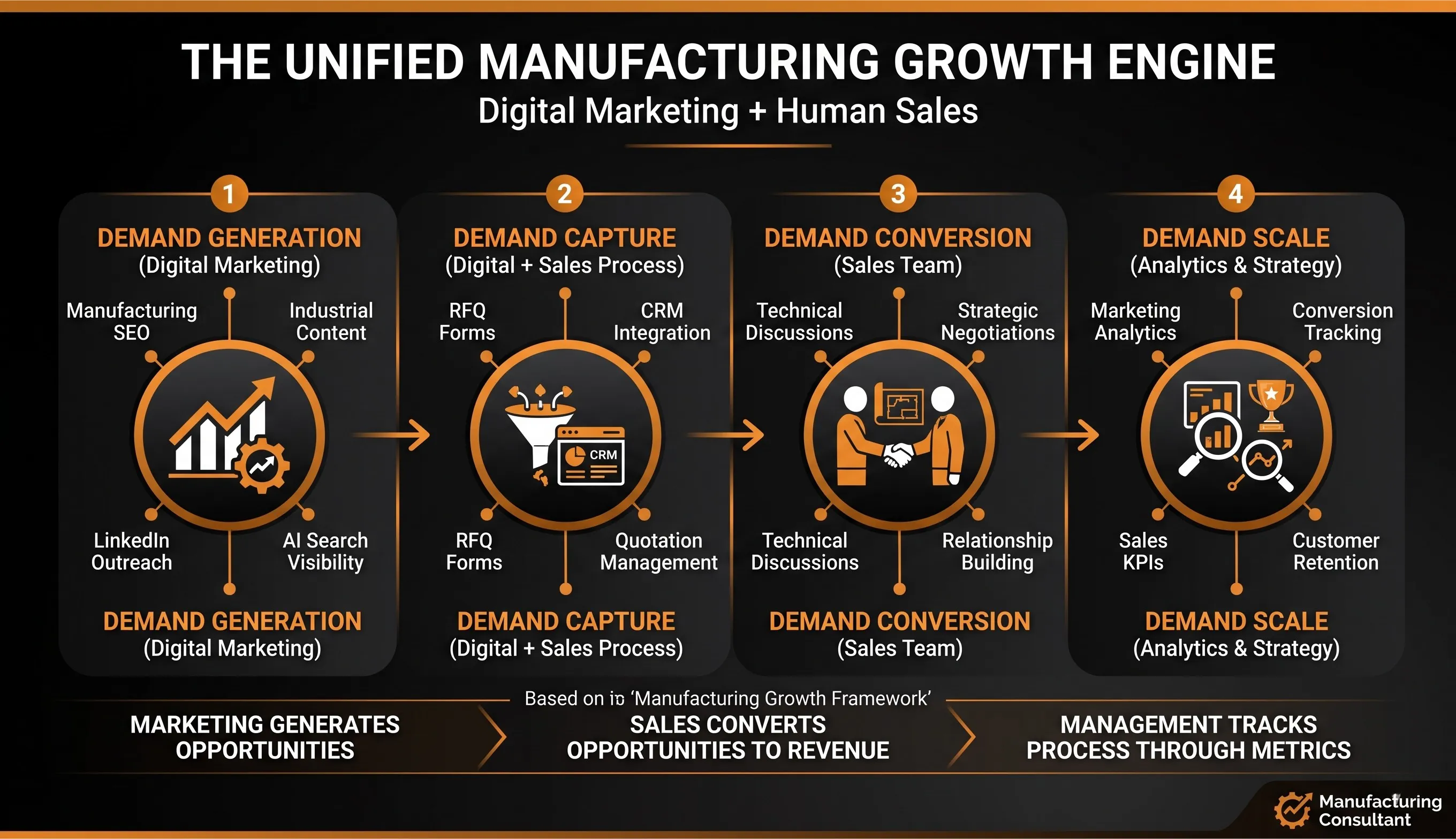
Rather than asking whether marketing can replace sales, we help manufacturers build one integrated revenue system across four stages:
01
Generate Demand
Manufacturing SEO, industrial content marketing, LinkedIn outreach, AI search visibility, and Google Ads - the inbound marketing layer that gets you discovered first.
02
Capture Demand
RFQ forms, landing pages, CRM systems, and lead qualification - so opportunities aren't lost once buyers find you.
03
Convert Demand
Technical discussions, consultative selling, commercial negotiation, and proposal management - where your outbound sales team takes over.
04
Scale Demand
Conversion tracking, marketing automation, sales performance monitoring, and retention programs - building a predictable, scalable growth engine.
What Manufacturers Should Measure
One of the first things we implement is KPI tracking across both sides of the sales funnel - not just revenue. Marketing KPIs: organic traffic, RFQs generated, qualified leads, cost per lead, website conversion rate. Sales KPIs: RFQ-to-quotation ratio, quotation-to-order ratio, average sales cycle, customer acquisition cost, customer lifetime value.
These metrics reveal whether a growth problem is a marketing problem or a sales problem. A company generating 100 RFQs a month with poor follow-up will often underperform one generating 30 RFQs with an excellent sales process. The issue isn't always B2B lead generation volume - sometimes it's conversion.
Our Perspective as a Manufacturing Consultant
After working with manufacturers across India and international markets, our conclusion is clear: digital marketing for manufacturing companies can replace prospecting, supplier discovery, and most traditional lead-generation legwork. It cannot replace technical expertise, relationship building, strategic negotiation, or account management.
The manufacturers growing fastest today aren't eliminating sales teams. They're equipping them with a predictable flow of qualified opportunities through a connected manufacturing sales and marketing system.
The real question isn't whether digital marketing can replace your sales team. It's: how much of your sales team's time is currently spent on activities that online lead generation and marketing automation could handle instead?
Ready for a Manufacturing Sales & Marketing Audit?
Connect with Tarun Gurwara and book a free 30-minute Manufacturing Sales & Marketing Audit for your manufacturing business.
Frequently Asked Questions
EntityCommercial
Can digital marketing replace salespeople in manufacturing?
No. Digital marketing can generate inquiries and RFQs, but salespeople remain essential for technical discussions, negotiations, and customer relationship management.
EntityCommercial
What part of the manufacturing sales process can be automated?
Lead generation, lead nurturing, inquiry management, follow-up reminders, and prospect qualification can be partially automated through digital marketing and CRM systems.
EntityGeo
Why do some manufacturing companies fail despite generating leads?
Common reasons include poor follow-up, delayed quotations, weak qualification processes, and lack of structured sales systems.
EntityCommercial
What generates better ROI for manufacturers: sales teams or digital marketing?
The highest ROI comes when digital marketing generates qualified opportunities and sales teams focus on converting those opportunities into customers.
Commercial
How can manufacturers reduce dependence on referrals?
By building a consistent manufacturing lead generation system using SEO, LinkedIn marketing, AI search optimization, content marketing, and targeted advertising.
EntityGeo
What KPIs should manufacturers track for sales and marketing performance?
Organic traffic, RFQs generated, qualified leads, cost per lead, website conversion rate, RFQ-to-quotation ratio, quotation-to-order ratio, average sales cycle, customer acquisition cost, and customer lifetime value.
Entity
What does digital marketing actually replace in manufacturing sales?
It can replace supplier discovery, initial prospecting, and basic qualification activities, reducing time spent on cold outreach, directory searching, and introductory calls by bringing prospects directly to your website.
EntityCommercial
What is the Manufacturing Growth Framework?
An integrated revenue system built on four stages: Generate Demand (SEO and LinkedIn), Capture Demand (RFQ forms and CRM), Convert Demand (consultative selling and negotiation), and Scale Demand (analytics and retention).
GeoCommercial
How does a manufacturing marketing consultant help companies grow?
By building complete customer acquisition systems - improving visibility through SEO and LinkedIn, generating qualified leads through RFQ systems and Google Ads, and improving conversion through CRM implementation and sales funnel design.
Build a Predictable Manufacturing Sales Pipeline
Ready to Build a Predictable Manufacturing Sales Pipeline?
Book a free 30-minute Manufacturing Sales & Marketing Audit with Tarun Gurwara. In 30 minutes, you'll know exactly whether your growth problem is a manufacturing lead generation problem or a conversion problem - and what to do next.
Ahmedabad, Gujarat, India · Digifacturing · Tarun Gurwara